
Palaeoscincus costatus, Leidy, 1856Troodon FORMOSUS
|
publication ID |
https://doi.org/10.5281/zenodo.1064078 |
|
persistent identifier |
https://treatment.plazi.org/id/E8728790-2E77-CC23-17B3-FDAEFB55FF21 |
|
treatment provided by |
Jeremy |
|
scientific name |
Palaeoscincus costatus Troodon FORMOSUS |
| status |
|
In association with the remains of the great extinct saurians, Trachodon and Deinodon , Dr. Hayden discovered the tooth of a true and gigantic representative of the family of Iguanians. The tooth is constructed on the same general plan as those of the existing Iguanas, consisting of a sub-palmate crown, with a compressed cylindrical fang.
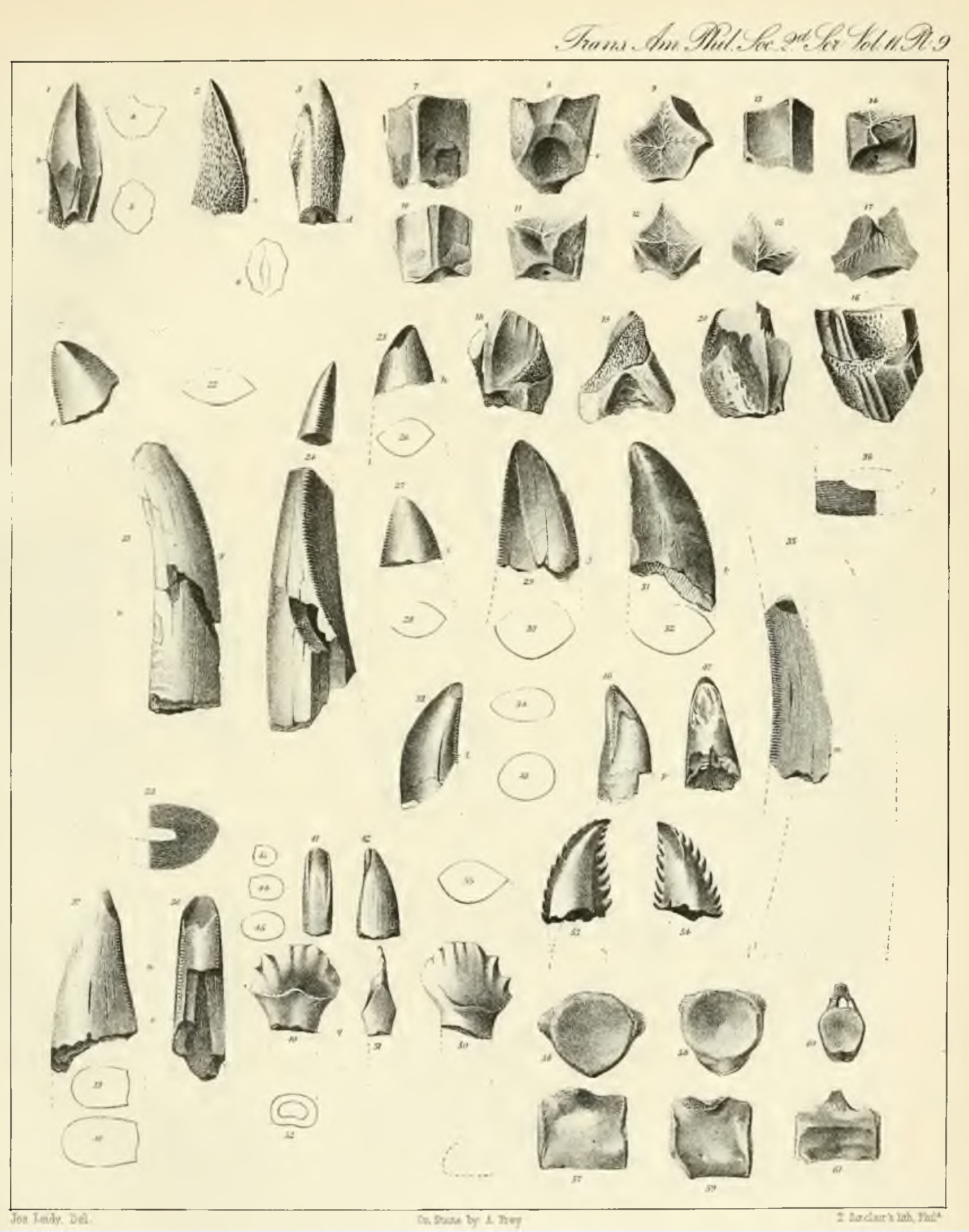
The crown of the fossil tooth, ( figs. 49—52, plate 9 View Figure ,) is compressed pyramidal with the apex truncated, and is broader than long. Its base is elevated into a ridge; and from the sides, ridges extend to the free borders of the crown, where they end in points, some of which are acute and others are blunt. From the basal ridge of the crown, the tooth gradually narrows into a compressed cylindrical, hollow fang, the lower part of which, in the specimen, is broken away.
The breadth of the crown of the fossil tooth is 4 lines; its length from the basal ridge is 2 1/2 lines; and its thickness in the position of the latter, is 1 1/2 lines. The breadth of the fang at its broken end, is 2 lines; its width, 1 1lines.
In structure, the tooth appears wholly composed of dentinal substance, and exhibits no trace of enamel upon the crown.
A proportionate increase in length of Palaeoscincus with the size of the teeth, in comparison with those of Iguana tuberculata , would give the animal a length of over thirty feet, which is however not probable, as we observe no necessary relation of length of animals in proportion with the size of their teeth.
In the same formation from which the tooth of Palaeoscincus was obtained, there were found about a dozen vertebral bodies, which may belong to the same animal, and if this is the case, we may obtain from them a more just idea of the size of the latter. These vertebral bodies are cylindroid, comparatively slightly constricted, and have the extremities slightly concave. In the true Iguanas the vertebral bodies have a totally different form, as they interlock with one another by a ball and socket joint; this, however, is no positive evidence that the fossil specimens do not belong to Palaeoscincus . Some of these vertebrae are represented in figures 5 6—61 View Figure , and they measure from 7 to 9 lines in length.
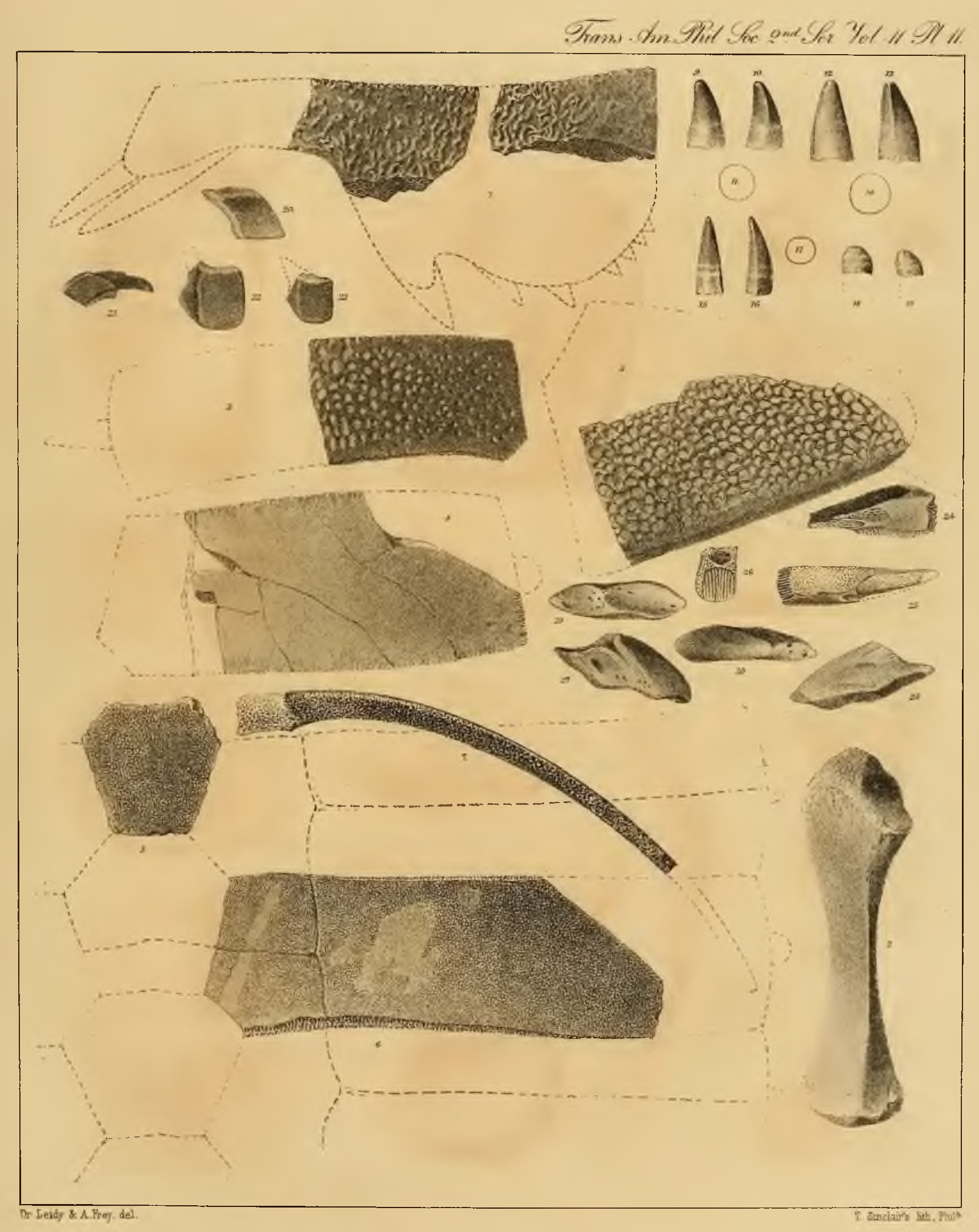
Accompanying the vertebral bodies, there is an ulna, represented in figure 8, plate 11 View Figure , which is solid, and perhaps belongs to the same animal.
Palaeoscincus , probably like the marine Amblyrhynchus of the Galapagos Islands, was aquatic and fed upon plants.
Explanation of Figures, Plates 9, 11.
Figures 49—52. Tooth of Palaeoscincus costatus ; magnified two diameters.
Figures 49, 50. Outer and inner views.
Figure 51. Apparently the forward view.
Figure 52. Section at the broken extremity of the specimen.
Figures 56—61. Vertebrae; of the size of Nature.
Figure 56. Anterior view of a dorsal vertebral body.
Figure 57. Lateral view.
Figure 58. Anterior view of an anterior caudal vertebra.
Figure 59. Lateral view.
Figure 60. Anterior view of a posterior caudal vertebra.
Figure 61. Lateral view.
Figure 8, plate 11. An ulna, natural size, suspected to belong to Palaeoscincus costatus Troodon FORMOSUS .
.
In association with the remains previously described from the Judith River, Dr. Hayden discovered the tooth of a large Monitor, to which the above name has been applied. Probably aquatic like many of the living Monitors, the voracious Troodon was most likely a troublesome enemy to the peaceful plant-eating Palaeoscincus .
The fossil tooth ( figs. 53-55, plate 9 View Figure ,) bears much resemblance to one of the lateral denticles of the teeth of the great extinct shark, Carcharodon angustidens , and under other circumstances might readily have been mistaken for such.
The specimen is black and shining, and is laterally compressed, conical, and curved backwards, as observed in the Monitor ornatus . The margins of the tooth are trenchant, and strongly denticulated; the denticles possessing the same form as the crown itself. On the convex border of the tooth there are eleven denticles, and on the concave border, seven; and on both borders the points of the denticles diverge upwardly.
The broken base of the crown is elliptically trapezoidal, and is hollowed on the interior. The crown is invested with enamel, which on one side of its summit is worn off by the attrition of an opposing tooth passing it like the blades of a pair of scissors. The length of the specimen is 3 lines; its antero-posterior diameter at base, 2 lines; and its transverse diameter, 1 1/2 lines.
I have no evidence that part of or all of the vertebrae supposed to belong to Palaeoscincus , do not really appertain to Troodon . This question must be left for future investigation to determine Explanation of Figures, Plate 9.
.
Figures 53—55. Tooth of Troodon formosus ; magnified three diameters.
Figure 53. Outer view.
Figure 5t. Inner view, exhibiting the enamel worn from the summit.
Figure 55. Section at the base of the specimen CHELONIA.
Troodon FORMOSUS ..
In association with the remains previously described from the Judith River, Dr. Hayden discovered the tooth of a large Monitor, to which the above name has been applied. Probably aquatic like many of the living Monitors, the voracious Troodon was most likely a troublesome enemy to the peaceful plant-eating Palaeoscincus .
The fossil tooth ( figs. 53-55, plate 9 View Figure ,) bears much resemblance to one of the lateral denticles of the teeth of the great extinct shark, Carcharodon angustidens , and under other circumstances might readily have been mistaken for such.
The specimen is black and shining, and is laterally compressed, conical, and curved backwards, as observed in the Monitor ornatus . The margins of the tooth are trenchant, and strongly denticulated; the denticles possessing the same form as the crown itself. On the convex border of the tooth there are eleven denticles, and on the concave border, seven; and on both borders the points of the denticles diverge upwardly.
The broken base of the crown is elliptically trapezoidal, and is hollowed on the interior. The crown is invested with enamel, which on one side of its summit is worn off by the attrition of an opposing tooth passing it like the blades of a pair of scissors. The length of the specimen is 3 lines; its antero-posterior diameter at base, 2 lines; and its transverse diameter, 1 1/2 lines.
I have no evidence that part of or all of the vertebrae supposed to belong to Palaeoscincus , do not really appertain to Troodon . This question must be left for future investigation to determine Explanation of Figures, Plate 9.
.
Figures 53—55. Tooth of Troodon formosus ; magnified three diameters.
Figure 53. Outer view.
Figure 5t. Inner view, exhibiting the enamel worn from the summit.
Figure 55. Section at the base of the specimen CHELONIA.
No known copyright restrictions apply. See Agosti, D., Egloff, W., 2009. Taxonomic information exchange and copyright: the Plazi approach. BMC Research Notes 2009, 2:53 for further explanation.