
Edessinae, Amyot & Serville, 1843
|
publication ID |
https://doi.org/10.11646/zootaxa.4377.2.6 |
|
publication LSID |
lsid:zoobank.org:pub:961E0020-EE4A-4FE3-902C-0478F8AE1449 |
|
DOI |
https://doi.org/10.5281/zenodo.5979854 |
|
persistent identifier |
https://treatment.plazi.org/id/AF3087D9-FF98-FFFA-5FFE-FBE4FA7E8D80 |
|
treatment provided by |
Plazi |
|
scientific name |
Edessinae |
| status |
|
Key to genera of Edessinae and subgenera of Edessa . Modified from Grazia et al. 2015
1. Body rounded; anterior apex of metasternal process not surpassing mesocoxae, sulcate but not clearly bifurcated ( Fig. 1 View FIGURES 1–10. 1–4 )...................................................................................... Brachystethus Laporte
- Body with different shapes but usually elongate, lateral margins subparallel; metasternal process clearly surpassing mesocoxae, anterior part with different shapes but never only sulcate ( Figs. 2–4 View FIGURES 1–10. 1–4 )........................................ 2
2. Metasternal process anteriorly clearly bifurcated ( Fig. 2 View FIGURES 1–10. 1–4 )...................................................... 4
- Metasternal process projected anteriorly in a simple process ( Figs. 3, 4 View FIGURES 1–10. 1–4 ).......................................... 3
3. Metasternal process long, surpassing procoxae ( Fig. 3 View FIGURES 1–10. 1–4 ), laterally compressed, fused with sterna; humeral angles slightly projected and acute.......................................................................... Pantochlora Stål
- Metasternal process short, not reaching procoxae ( Fig. 4 View FIGURES 1–10. 1–4 ), conical, not in contact with sterna; humeral angles projected laterally, apices sharp................................................................ Doesburgedessa Fernandes
4. Antennae four-segmented; second antennomer very long, at least three times longer than the first ( Fig. 5 View FIGURES 1–10. 1–4 ); humeral angles globose......................................................................... Peromatus Amyot & Serville
- Antennae five-segmented ( Fig. 6 View FIGURES 1–10. 1–4 ); second antennomer short, at most twice longer than the first; humeral angles variable in shape............................................................................................... 5
5. Posterior margin of pronotum with a large pair of spines overlapping basal angles of scutellum ( Fig. 7 View FIGURES 1–10. 1–4 ); humeral angles long, sinuous, and laterally directed..................................................................... Olbia Stål
- Posterior margin of pronotum without large spines or other projections ( Fig. 8 View FIGURES 1–10. 1–4 ); humeral angles variable in shape......... 6
6. Head with 6-8 solid black stripes, punctures of the head concentrated on these stripes ( Fig. 9 View FIGURES 1–10. 1–4 ); proctiger with a medial carina on posterior face.......................................................... Grammedessa Correia & Fernandes
- Head with punctures sparse or concentrated but never on black solid lines ( Fig. 10 View FIGURES 1–10. 1–4 ); posterior face of proctiger without medial carina............................................................................................... 7
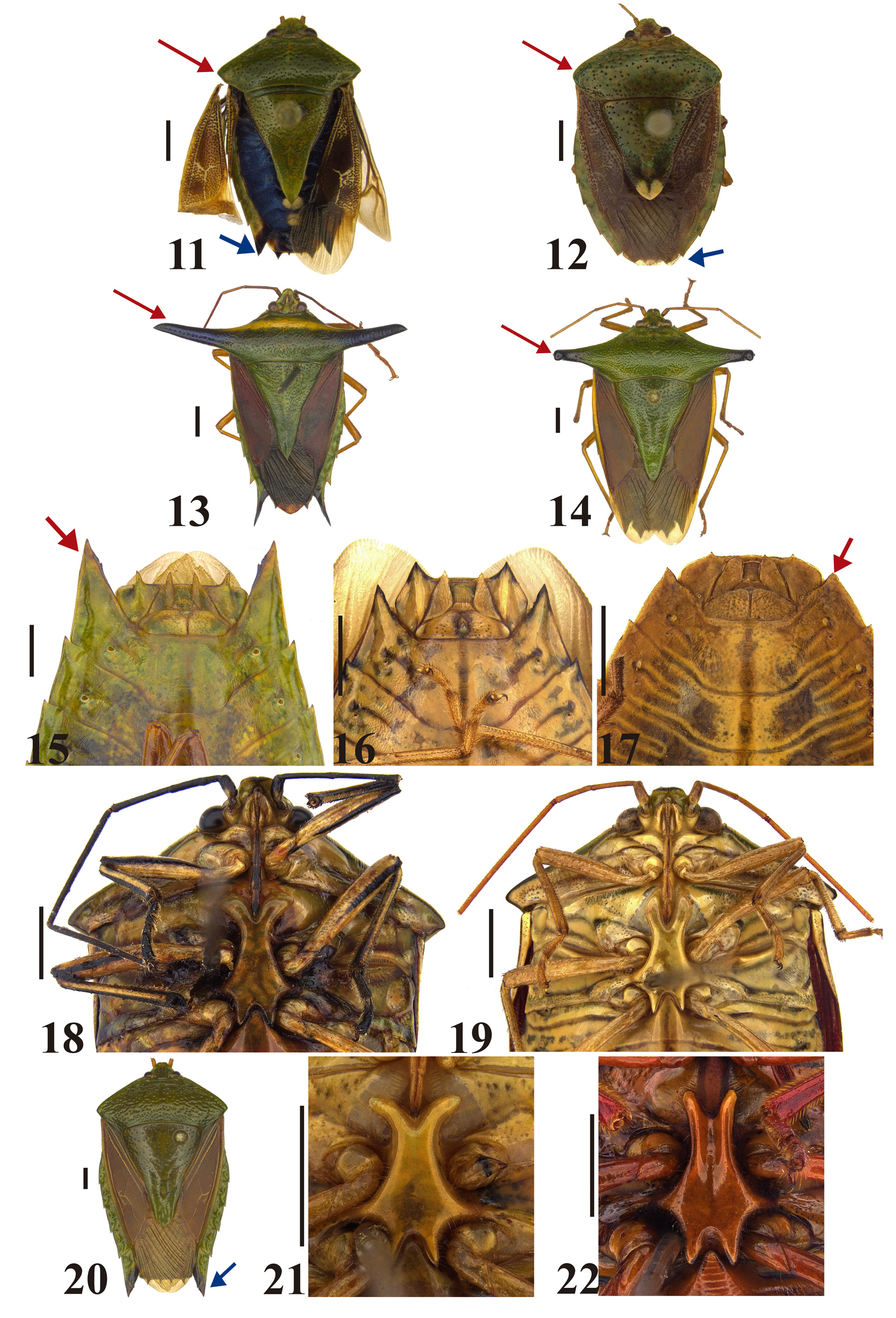
7. Humeral angles rounded or acute but shorter than head width ( Figs. 11, 12 View FIGURES 11–22. 11–14 )........................................ 8
- Humeral angles globose, depressed dorsoventrally or acute and normally longer than head width ( Figs. 13, 14 View FIGURES 11–22. 11–14 ).......... 12
8. Species elongate; humeral angles acute ( Fig. 11 View FIGURES 11–22. 11–14 , red arrow); abdominal segment VII projected posteriorly ( Figs. 15, 16 View FIGURES 11–22. 11–14 ) and contrastingly dark at least in distal half ( Figs. 11, 20 View FIGURES 11–22. 11–14 )......................................................... 9
- Species rounded; humeral angles rounded ( Fig. 12 View FIGURES 11–22. 11–14 , red arrow); abdominal segment VII not posteriorly projected ( Fig. 17 View FIGURES 11–22. 11–14 ) and concolorous with connexivum ( Fig. 12 View FIGURES 11–22. 11–14 )................................................................... 13
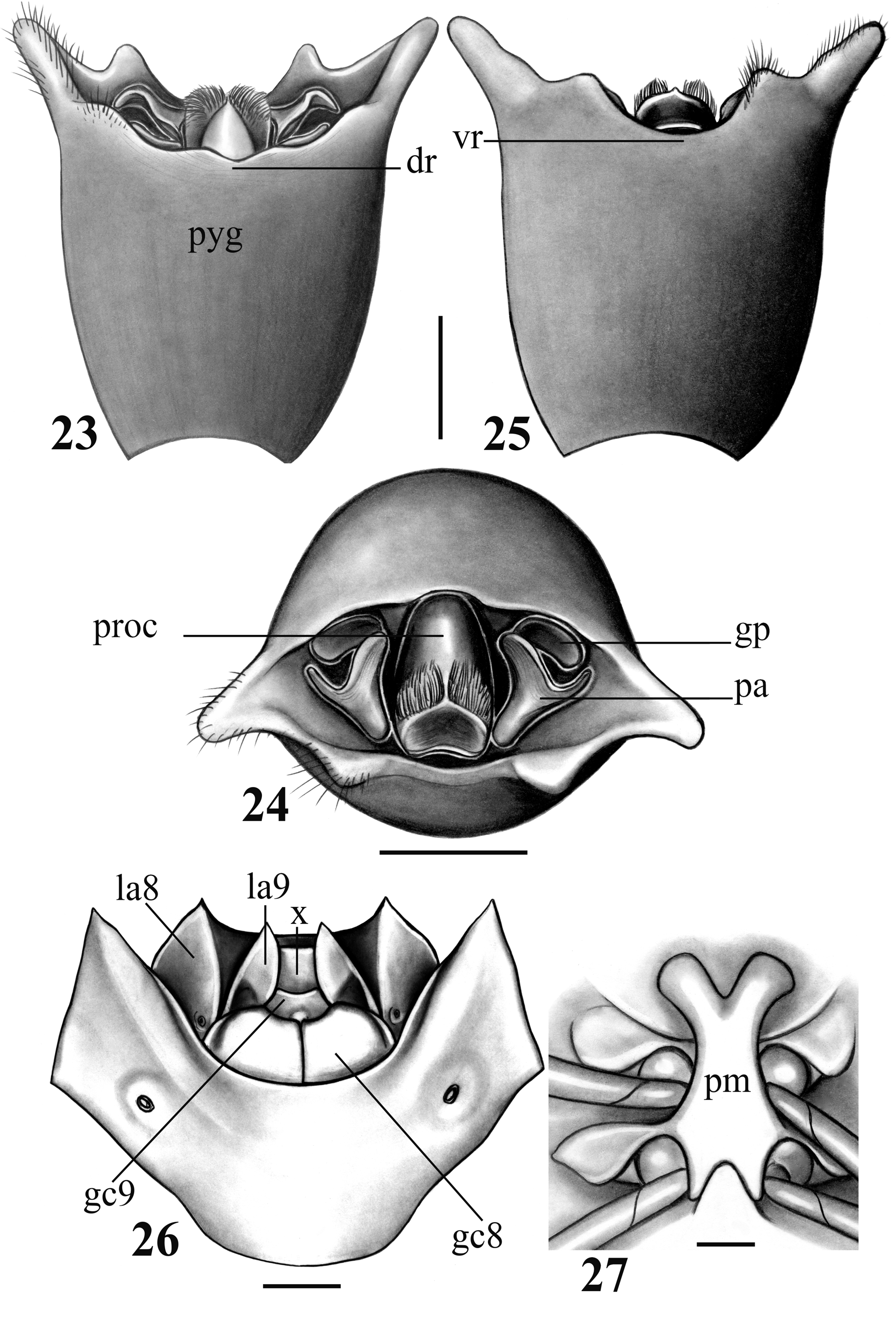
9. Legs with black stripes ( Fig. 18 View FIGURES 11–22. 11–14 ); antennae black, except first segment with a ventral yellow spot ( Fig. 18 View FIGURES 11–22. 11–14 ); pygophore with posterolateral angles developed and posterolaterally directed ( Figs. 23–25 View FIGURES 23–27 ); females with gonapophysis 9 bearing a small
tumescence at the base of gonocoxites 9 ( Figs. 40, 41 View FIGURES 40–43. 40–41 )........................................ Plagaedessa gen. n. - Legs unicolorous ( Fig. 19 View FIGURES 11–22. 11–14 ); antennae yellow to light brown ( Fig. 19 View FIGURES 11–22. 11–14 ); pygophore with posterolateral angles barely developed and posteriorly directed; females without tumescence on gonapophysis 9........................................ 10
10. Corium uniformly brown with contrastingly yellow veins sometimes strongly branched ( Fig. 20 View FIGURES 11–22. 11–14 ); abdominal segment VII at least 1.5 times longer than wide at base ( Fig. 15 View FIGURES 11–22. 11–14 ); proctiger with posterior face rounded; phallus with a distal constriction; capsula seminalis as big as or bigger than laterotergites 8 and 9...........................subg. Pygoda Amyot & Serville
- Corium brown variegate with whitish and blackish spots ( Figs. 8 View FIGURES 1–10. 1–4 , 11 View FIGURES 11–22. 11–14 ); abdominal segment VII at most 1.2 times longer than wide at base ( Fig. 16 View FIGURES 11–22. 11–14 ); proctiger with posterior face flat; phallus not constricted distally; capsula seminalis smaller than laterotergitos 8 and 9.................................................................................... 11
11. Pronotum unicolorous ( Fig. 11 View FIGURES 11–22. 11–14 ); dorsal surface of abdomen mostly metallic blue ( Fig. 11 View FIGURES 11–22. 11–14 ); posterior part of proctiger expanded laterally in a flat plate (see Silva et al. 2013 — Figs. 2 View FIGURES 1–10. 1–4 , 27 View FIGURES 23–27 ); gonocoxites 8 somewhat reduced, leaving visible the sclerotized gonapophyses 8............................................................... Paraedessa Silva & Fernandes
- Pronotum with dark transversal stripe ( Fig. 8 View FIGURES 1–10. 1–4 ); dorsal surface of abdomen never metallic blue; posterior part of proctiger not expanded laterally, posterior face thick; gonocoxites 8 never reduced, leaving visible at most a tiny membranous part of gonapophyses 8............................................................ subg. Hypoxys Amyot & Serville
12. Humeral angles long, apex acute ( Fig. 13 View FIGURES 11–22. 11–14 , red arrow); abdominal segment VII twisted and strongly projected posteriorly, far surpassing genital plates or pygophore; pronotum with an anterior yellow stripe ( Fig. 13 View FIGURES 11–22. 11–14 )...................................................................................................... subg. Dorypleura Amyot & Serville
- Humeral angles variable in length, apex globose ( Fig. 14 View FIGURES 11–22. 11–14 , red arrow); abdominal segment VII not twisted and not projected as far posteriorly as above, not reaching to slightly surpassing genital plates or pygophore; pronotum without anterior yellow stripe ( Fig. 14 View FIGURES 11–22. 11–14 ) (except Edessa pictiventris Stål, 1872 )...................................... subg. Edessa Fabricius View in CoL
13. Pronotal disk tumid; body covered with dark punctures; arms of the metasternal process developed and sometimes slightly laterally compressed ( Fig. 21 View FIGURES 11–22. 11–14 ); Central America (except Ascra bifida Say, 1832 also found in north part of South America).................................................................................................. Ascra Say
- Pronotal disk not tumid; body covered with concolorous or light brown punctures; arms of the metasternal process strongly laterally compressed ( Fig. 22 View FIGURES 11–22. 11–14 ), barely developed in some species; South America (except the widespread species Edessa rufomarginata (De Geer, 1773)) ................................................. subg. Aceratodes Amyot & Serville


No known copyright restrictions apply. See Agosti, D., Egloff, W., 2009. Taxonomic information exchange and copyright: the Plazi approach. BMC Research Notes 2009, 2:53 for further explanation.
|
Kingdom |
|
|
Phylum |
|
|
Class |
|
|
Order |
|
|
Family |