
Procestus jatai, Herrera-Flórez & Penteado-Dias, 2021
|
publication ID |
https://doi.org/10.11646/zootaxa.4941.4.4 |
|
publication LSID |
lsid:zoobank.org:pub:6E07789B-8BAD-45DE-9CE8-2C89AB3911A3 |
|
DOI |
https://doi.org/10.5281/zenodo.4595672 |
|
persistent identifier |
https://treatment.plazi.org/id/FA6C87AD-3D47-FFBC-D2D2-FC89FB8DFEEB |
|
treatment provided by |
Plazi |
|
scientific name |
Procestus jatai |
| status |
sp. nov. |
Procestus jatai n. sp. Herrera-Flórez & Penteado-Dias
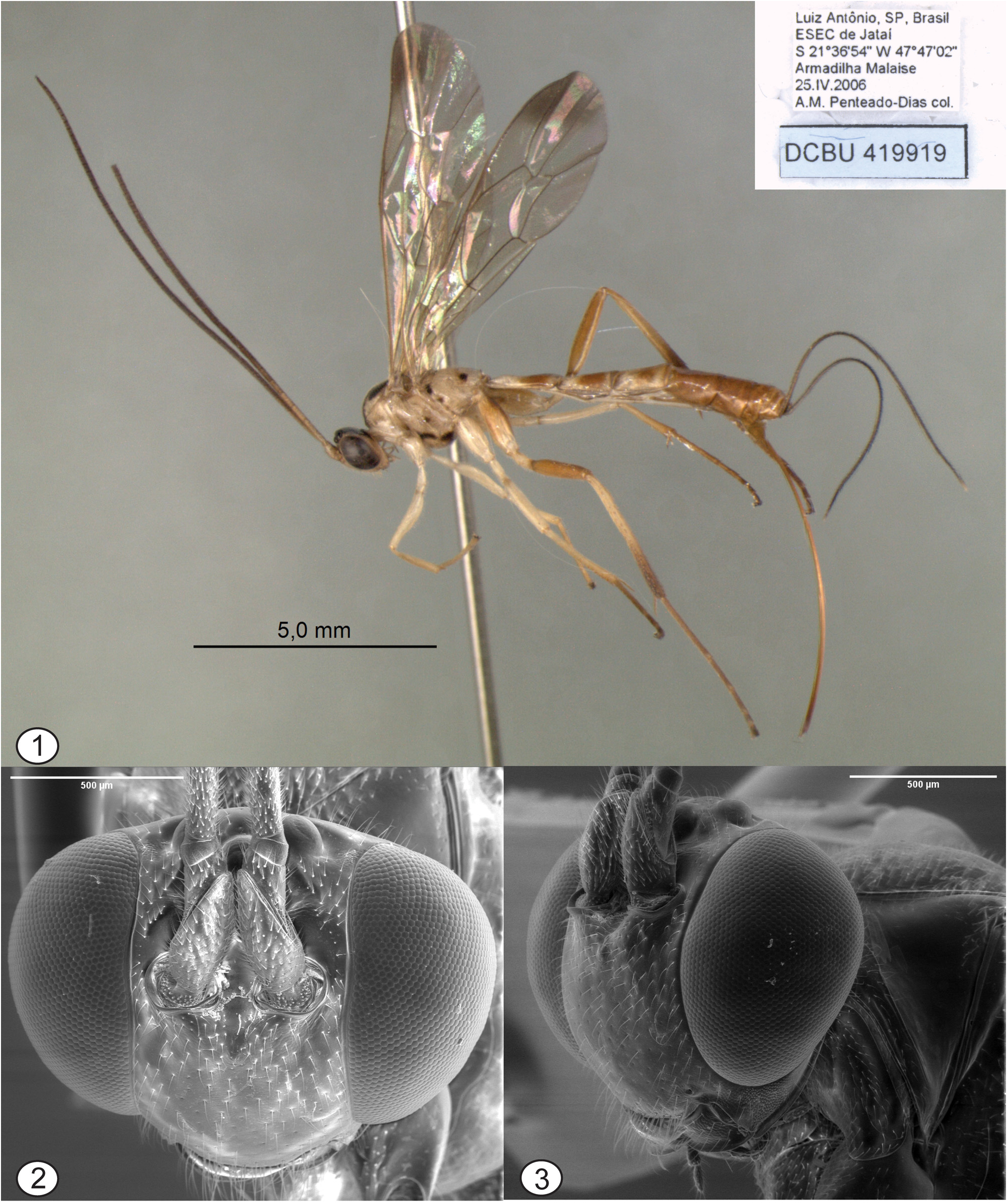
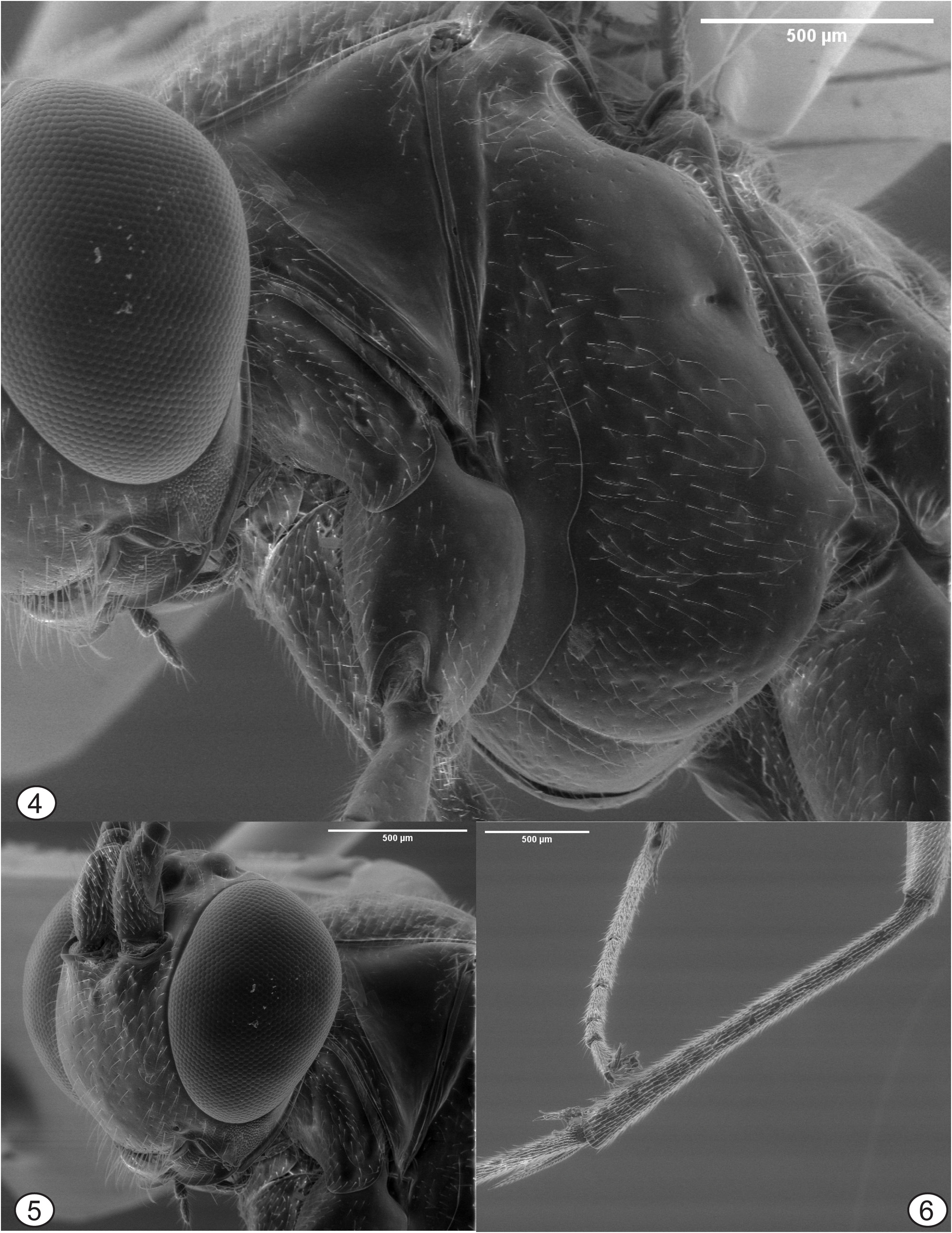
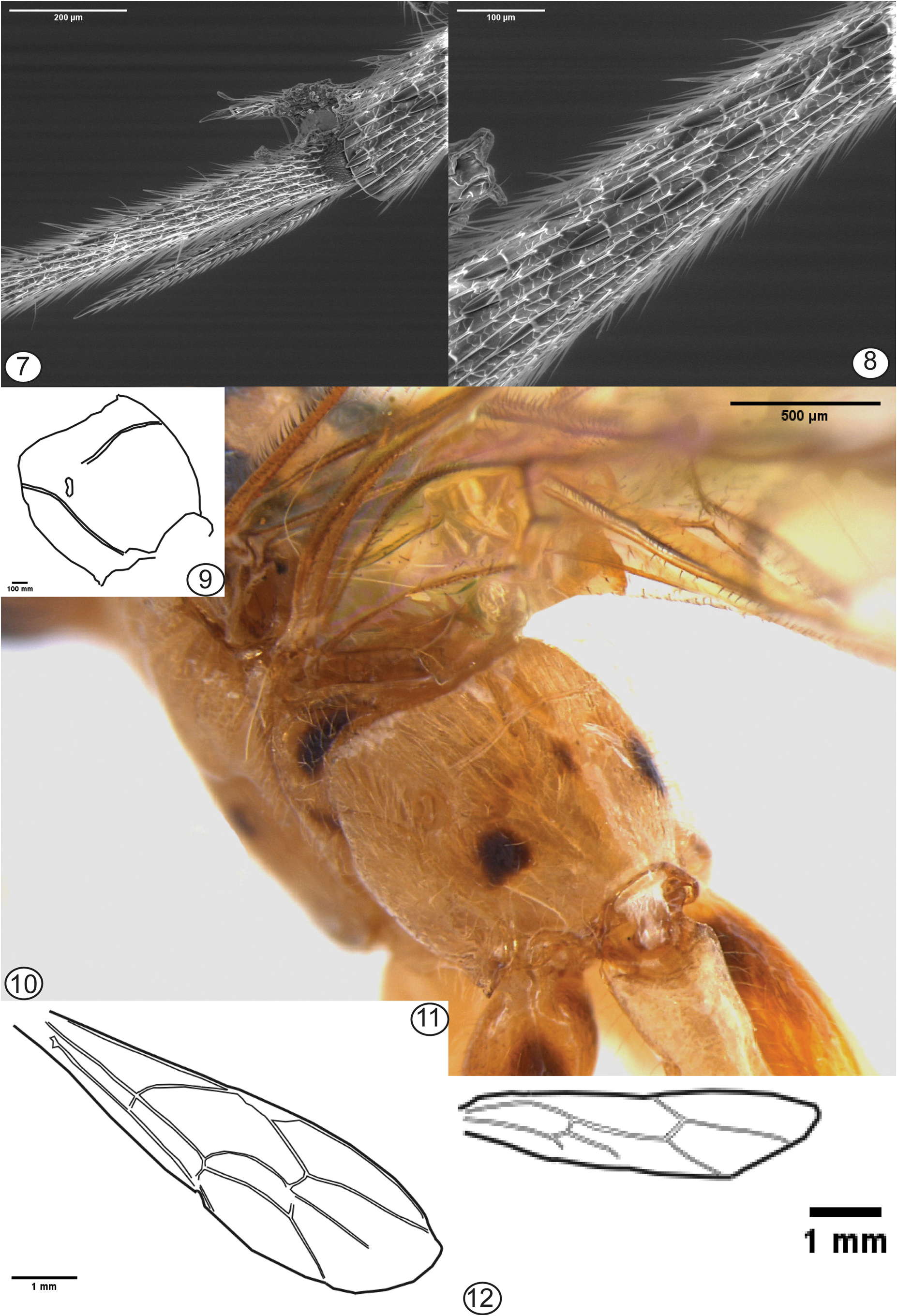
( Figs 1–13 View FIGURES 1–3 View FIGURES 4–6 View FIGURES 7–12 View FIGURE 13 )
Material examined. Holotype: female, Luis Antonio, SP, Brasil ESEC de Jatai S 21º36´54” W 47º47´02” Armadilha Malaise 25.IV.2006 A.M.Penteado-Dias col. DCBU 419919 View Materials GoogleMaps , Paratype: female, Luis Antonio, SP, Brasil ESEC de Jatai S 21º36´54” W 47º47´02” Armadilha Malaise 09. V GoogleMaps .2007 A.M.Penteado-Dias col. DCBU 419920 View Materials .
Diagnosis. This new species of Procestus , can be recognized by the following combination of characters: epomia ending dorsally below upper edge of pronotum; posterior transverse carina absent; frons simple; metasoma mostly yellow; metapleuron mostly yellow; apical part of fore wing with a blackish spot.
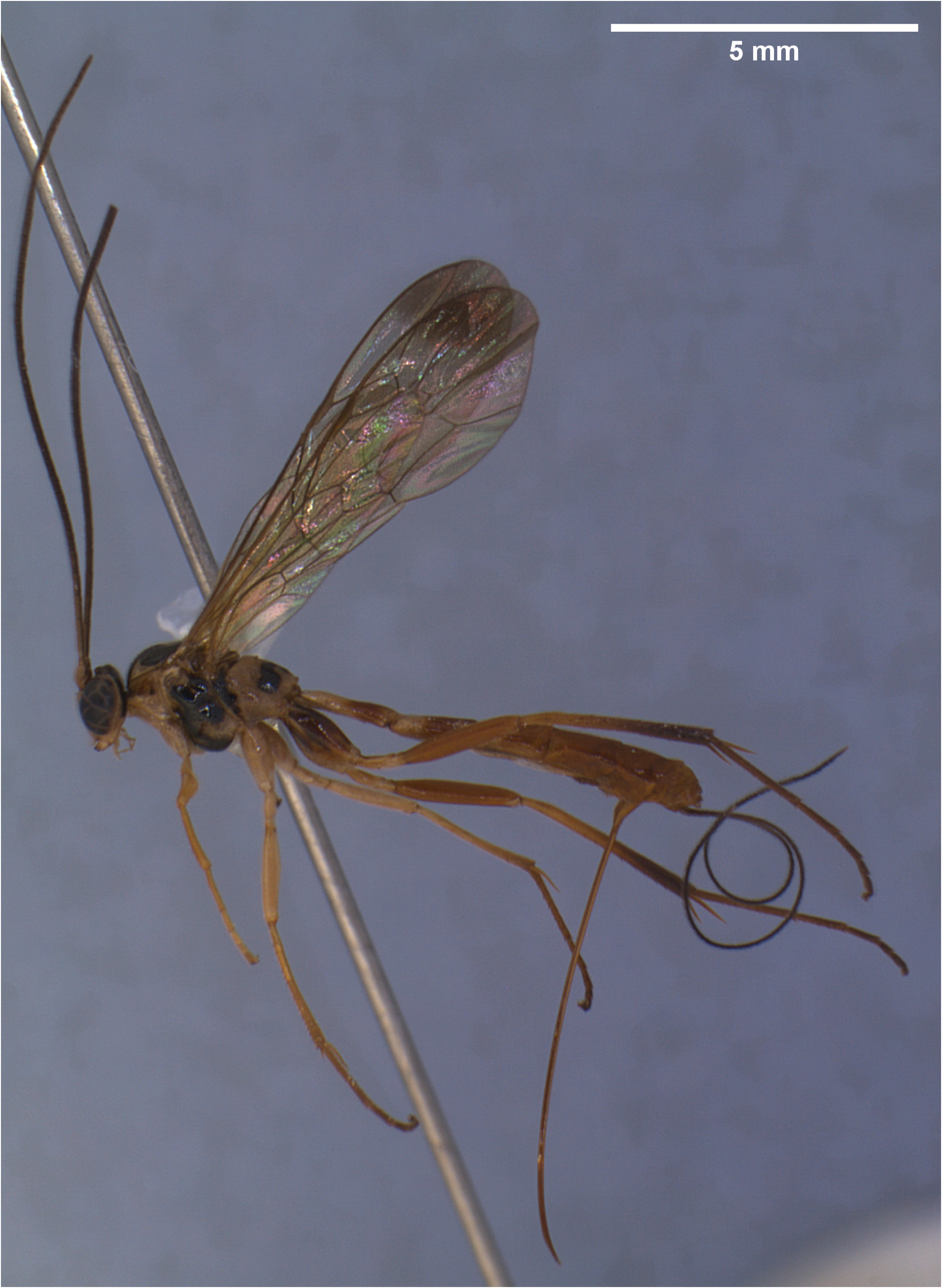
Description. Female ( Fig. 1 View FIGURES 1–3 ): Fore wing length 7.6 mm; hind wing length 5.2 mm.
Head. Malar space about 0.7 × as long as basal mandibular width ( Figs 4 & 5 View FIGURES 4–6 ); frons simple ( Figs 2, 3 View FIGURES 1–3 & 5 View FIGURES 4–6 ), ocelli median, the posterior one separated from the orbit by about 0.8 × its own maximum diameter ( Figs 2 View FIGURES 1–3 & 5 View FIGURES 4–6 ); gena flat behind eye; occipital carina not broadened into a flange ( Fig. 1 View FIGURES 1–3 ); antenna slender, with 41 flagellomeres.
Mesosoma. Epomia ( Figs 4 & 5 View FIGURES 4–6 ) ending dorsally below upper edge of pronotum; mesoscutum with fine setiferous punctures over most of its surface ( Figs 4 & 5 View FIGURES 4–6 ); mesopleuron with sparse setiferous punctures anteriorly ( Fig. 4 View FIGURES 4–6 ); metapleuron from the middle to the upper margin with sparse setiferous punctures ( Fig. 4 View FIGURES 4–6 ); pleural carina complete ( Fig. 4 View FIGURES 4–6 ); propodeum without posterior transverse carina ( Figs 9 & 10 View FIGURES 7–12 ); fore tarsal claws with slender, pale-colored pecten teeth on their basal 0.7; mid tibia with 27 small denticles on outer surface ( Fig. 8 View FIGURES 7–12 ); fore wing with bulla in 2m-cu vein 0.8 as long as the rest of this vein ( Figs 1 View FIGURES 1–3 & 11 View FIGURES 7–12 ); hind wing with nervellus (composite vein first abscissa of CU&cu-a) intercepted at its center ( Fig. 12 View FIGURES 7–12 ).
Metasoma. Metasoma with tergite I very slender ( Fig. 1 View FIGURES 1–3 ), about 3.9 × as long as posteriorly broad; ovipositor projecting beyond apex of metasoma by about 2.4 × the length of the hind tibia ( Fig. 1 View FIGURES 1–3 ).
Coloration ( Fig. 1 View FIGURES 1–3 ). Head yellow with apex of mandibles brownish; central part of vertex and occiput black; antenna brown, with scape, pedicel, flagellomeres I–III yellow. Mesoscutum yellow with three longitudinal strips and a posterior blackish spot; mesopleuron yellow with two ventral blackish spots and a central brownish spot; metanotum with transverse dark brown strips, propodeum with lateral dark brown spots; fore legs yellow; mid legs yellow with tarsi dark orange; tarsomere 5 brownish; hind legs mostly orange. Metasoma tergite I–III mostly (anteriorly and posteriorly) yellow, the rest orange; tergite IV–VII orange; wings infumate with an apical brownish spot; pterostigma light brown.
Variation. Paratype: Fore wing length 6.8 mm; hind wing length 4.7 mm. Malar space about 0.5 × as long as basal mandibular width; posterior ocelli separated from the orbit by about 0.7 × its own maximum diameter. Fore tarsal claws with slender pale-colored pecten teeth on their basal 0.6; mid tibia with 21 small denticles on outer surface; fore wing with bulla in 2m-cu vein 0.6 as long as the rest of this vein. Metasoma with tergite I very slender ( Fig. 13 View FIGURE 13 ), about 3.1 × as long as posteriorly broad; ovipositor projecting beyond apex of metasoma by about 2.2 × the length of the hind tibia ( Fig. 13 View FIGURE 13 ).
Coloration ( Fig. 13 View FIGURE 13 ). Mesosoma, specially mesopleuron and propodeum most extensively black marked.
Etymology: The name refers to the type locality (i.e. The Jataí Ecological Station).
| ESEC |
Entomological Society of Egypt |
| V |
Royal British Columbia Museum - Herbarium |
No known copyright restrictions apply. See Agosti, D., Egloff, W., 2009. Taxonomic information exchange and copyright: the Plazi approach. BMC Research Notes 2009, 2:53 for further explanation.
|
Kingdom |
|
|
Phylum |
|
|
Class |
|
|
Order |
|
|
Family |
|
|
Genus |