
Pestalotiopsis rhodomyrtus, Song & Geng & Zhang & Hyde & Zhao & Wei & Kang & Wang, 2013
|
publication ID |
https://doi.org/10.11646/phytotaxa.126.1.2 |
|
DOI |
https://doi.org/10.5281/zenodo.5085263 |
|
persistent identifier |
https://treatment.plazi.org/id/A520F505-6666-C75D-FF4E-FEB7FACFFB9B |
|
treatment provided by |
Felipe |
|
scientific name |
Pestalotiopsis rhodomyrtus |
| status |
|
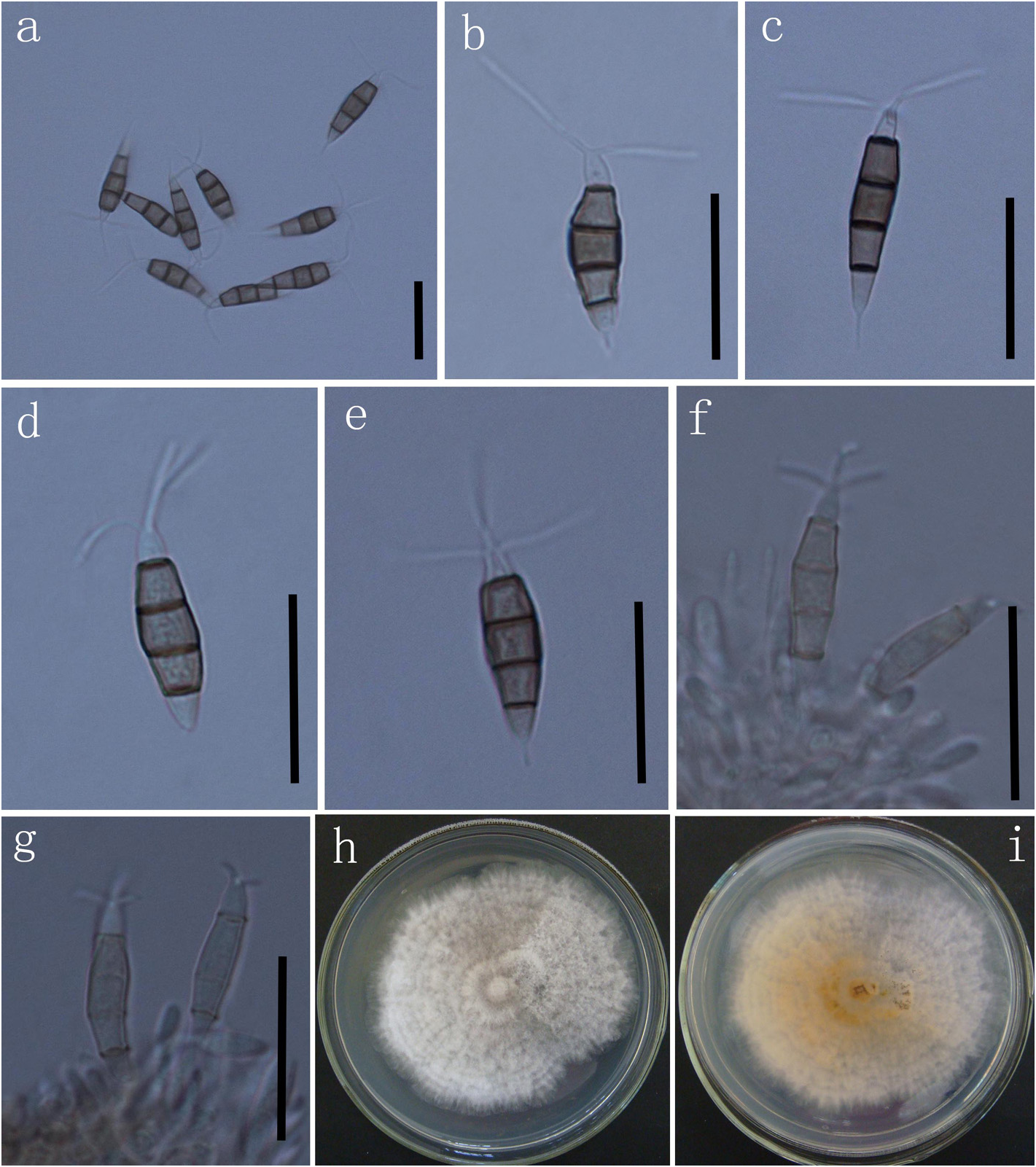
Pestalotiopsis rhodomyrtus Y. Song, K. Geng, K.D. Hyde & Yong Wang bis, sp. nov. ( Fig. 3 View FIGURE 3 ) MycoBank MB
804968
Differs from Pestalotiopsis rosea and P. adusta by bigger conidia and its apical appendages, which are shorter than those of P. trachicarpicola and P. rosea .
Type: — CHINA. Guangxi Province: Liangfeng River National Forest Park, isolated from leaves of Rhodomyrtus tomentosa, 2011, J.G. Wei ( HGUP4230 , holotype!) .
Conidiophores indistinct. Conidiogenous cells discrete, hyaline, simple, filiform. Conidia 19.7–26.3 × 4.9–6.7 µm (n=30, x =23.00 × 5.76 µm), fusoid, straight to slightly curved, 4-septate; basal cell conic to obconic, hyaline or pale brown, smooth, thin-walled, 3.6–6.4 µm long (n=30, x = 4.79 µm); three median cells 12.9– 16.8 µm long (n=30, x = 15.04 µm), brown, septa and periclinal walls darker than the rest of the cell, concolorous, verruculous; second cell from base 4.3–5.8 µm long (n=30, x = 5.12 µm); third cell from base 3.5–5.7 µm long (n=30, x = 4.73 µm); fourth cell from base 4.3–5.6 µm long (n=30, x = 4.88 µm); apical cell hyaline, obconic to subcylindrical, 2.7–4.1 µm long (n=30, x = 3.56 µm); with 2–3 tubular appendages, arising from the apex of the apical cell, 7.5–14.9 µm long (n=30, x = 10.54 µm), unequal; one basal appendage present, 2.8–4.9 µm long (n=30, x = 3.65 µm), filiform.
Colonies on PDA reaching 7 cm diam. after 8 days at 25°C, with edge crenate, whitish, aerial mycelia on surface, fruiting bodies black, gregarious; reverse of colony pale orange.
Etymology: —In reference to the host, Rhodomyrtus tomentosa, from which this fungus was first isolated.
Habitat/Distribution: —Known to inhabit Rhodomyrtus tomentosa, Guangxi Province, China.
| PDA |
Royal Botanic Gardens |
No known copyright restrictions apply. See Agosti, D., Egloff, W., 2009. Taxonomic information exchange and copyright: the Plazi approach. BMC Research Notes 2009, 2:53 for further explanation.
|
Kingdom |
|
|
Phylum |
|
|
Class |
|
|
Order |
|
|
Family |
|
|
Genus |