
Vespa orientalis Linnaeus, 1771
|
publication ID |
https://doi.org/10.5281/zenodo.281144 |
|
persistent identifier |
https://treatment.plazi.org/id/827E6B37-FFDB-FF9A-FF47-FA67FD70F8A0 |
|
treatment provided by |
Plazi |
|
scientific name |
Vespa orientalis Linnaeus, 1771 |
| status |
|
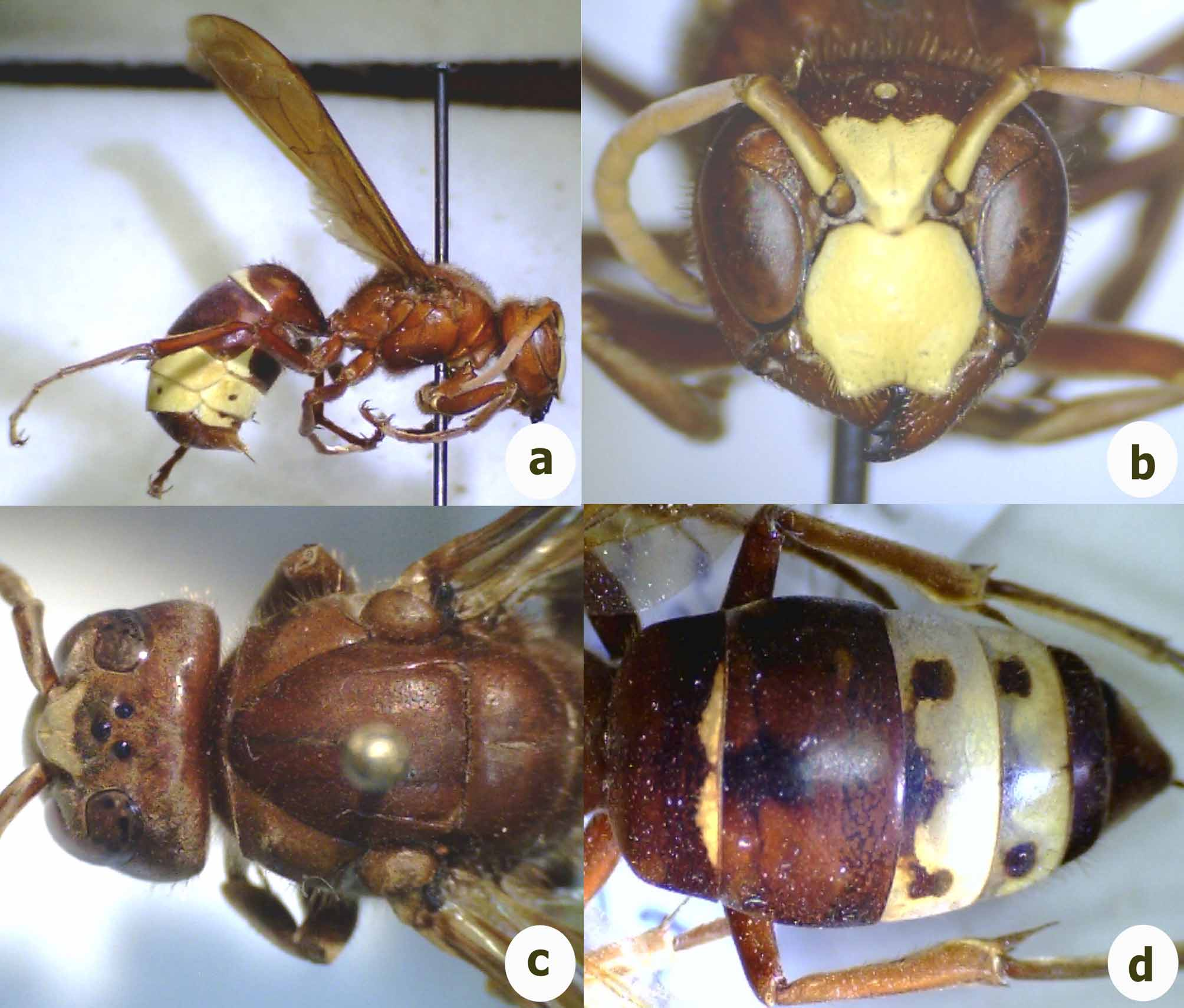
Vespa orientalis Linnaeus, 1771
Figs 2 View FIGURE 2 (a–d)
Female: Body length 20–26 mm (n = 36), fore wing length 18–20 mm (n = 36). Male: Body length 22 mm (n = 1), fore wing length 19.5 (n = 1).
Material examined. PAKISTAN: Gilgit-Baltistan: Chillas, 1 Ψ, 04.viii. 1987, Dassu, 1 Ψ, 14.viii. 1988, Gilgit, 1 Ψ, 16.viii. 1988, Abro; Nomal, 3 Ψ, 24.ix. 1987, Afzal ( PMNH). Khyber Pakhtunkhwa: Bannuu, 2 Ψ, 09.ix. 1988, Afzal; Peshawar, 3 Ψ, 23.x. 2007, Khalid; Peshawar, 1 ɗ & 1 Ψ, 23–27.x. 2007, Malaise trap; Kohat, 1 Ψ, 24.x. 2007, Mishkat Ullah; Charsada, Ser Deryab, 1 Ψ, 25.x. 2007, Fida; Peshawar, Warsak, 4 Ψ, 26.x. 2007, Fida ( PMNH). Abbottabad, 6 Ψ, 20.viii. 2008, 3Ψ, 21.viii. 2008, Mansehra, 1 Ψ, 22.viii. 2008, Mardan, 2 Ψ, 25.viii. 2008, Peshawar, 3 Ψ, 28.viii. 2008, Peshawar, 1 Ψ, 29.viii. 2008, Aziz ( AUPKP). Punjab: Islamabad, 1 Ψ, 21.iv. 2008, Fida; Fort Abbas, 1 Ψ, 13.iv. 2009, Mishkat Ullah ( PMNH).
Distribution. This species is widespread from southern Italy and Libya in the west to India and Nepal in the east, including Pakistan ( Gusenleitner 2010).
| PMNH |
Peabody Museum of Natural History |
No known copyright restrictions apply. See Agosti, D., Egloff, W., 2009. Taxonomic information exchange and copyright: the Plazi approach. BMC Research Notes 2009, 2:53 for further explanation.
|
Kingdom |
|
|
Phylum |
|
|
Class |
|
|
Order |
|
|
Family |
|
|
Genus |