
Meranoplus mayri Forel, 1910
|
publication ID |
https://dx.doi.org/10.11646/zootaxa.3635.4.1 |
|
publication LSID |
lsid:zoobank.org:pub:9DB4A023-F9B4-4257-900B-F672F93CD845 |
|
persistent identifier |
https://treatment.plazi.org/id/644B87DB-FFCE-FFB2-7EB2-FB9FF929FDBD |
|
treatment provided by |
Plazi |
|
scientific name |
Meranoplus mayri Forel, 1910 |
| status |
|
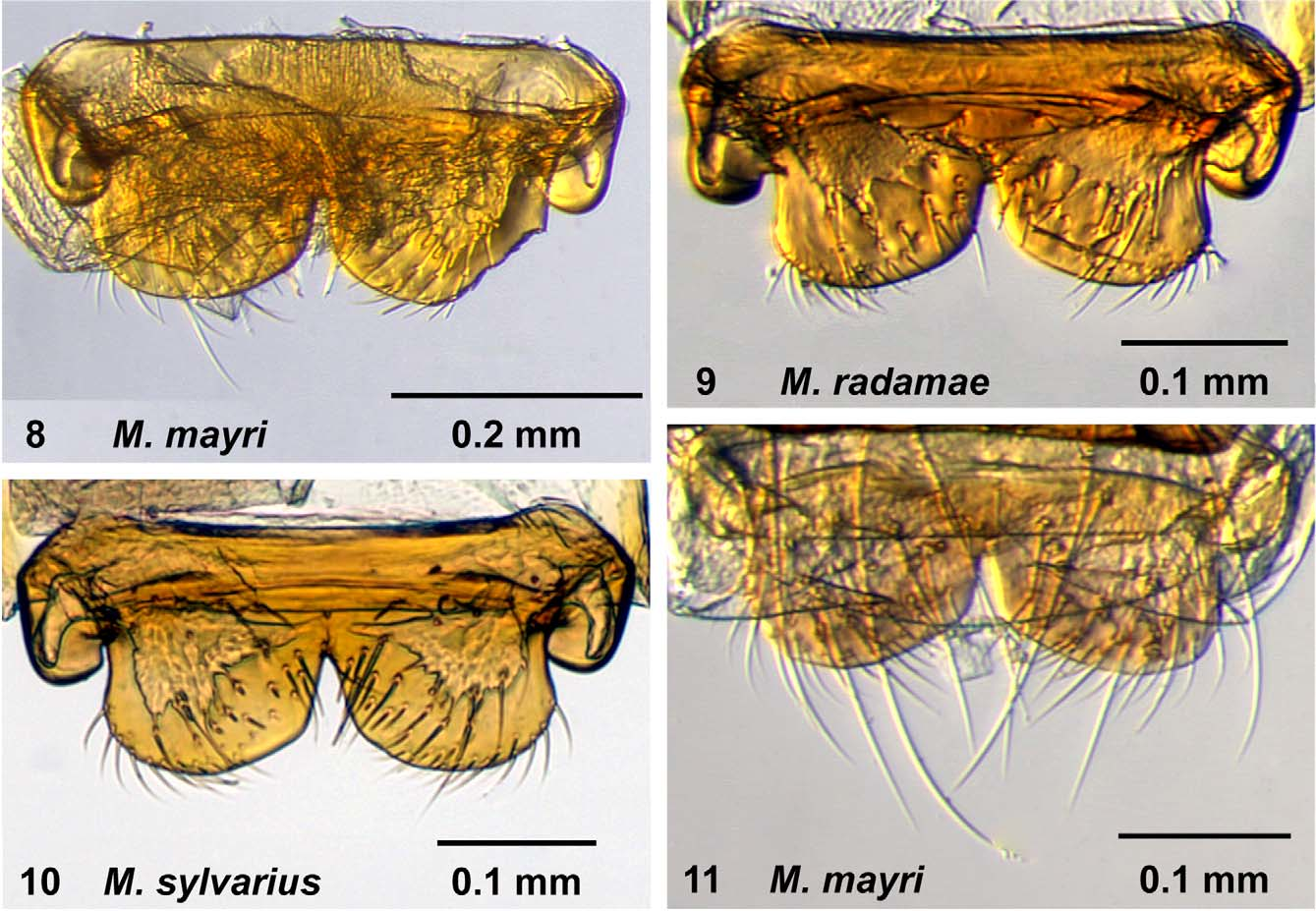
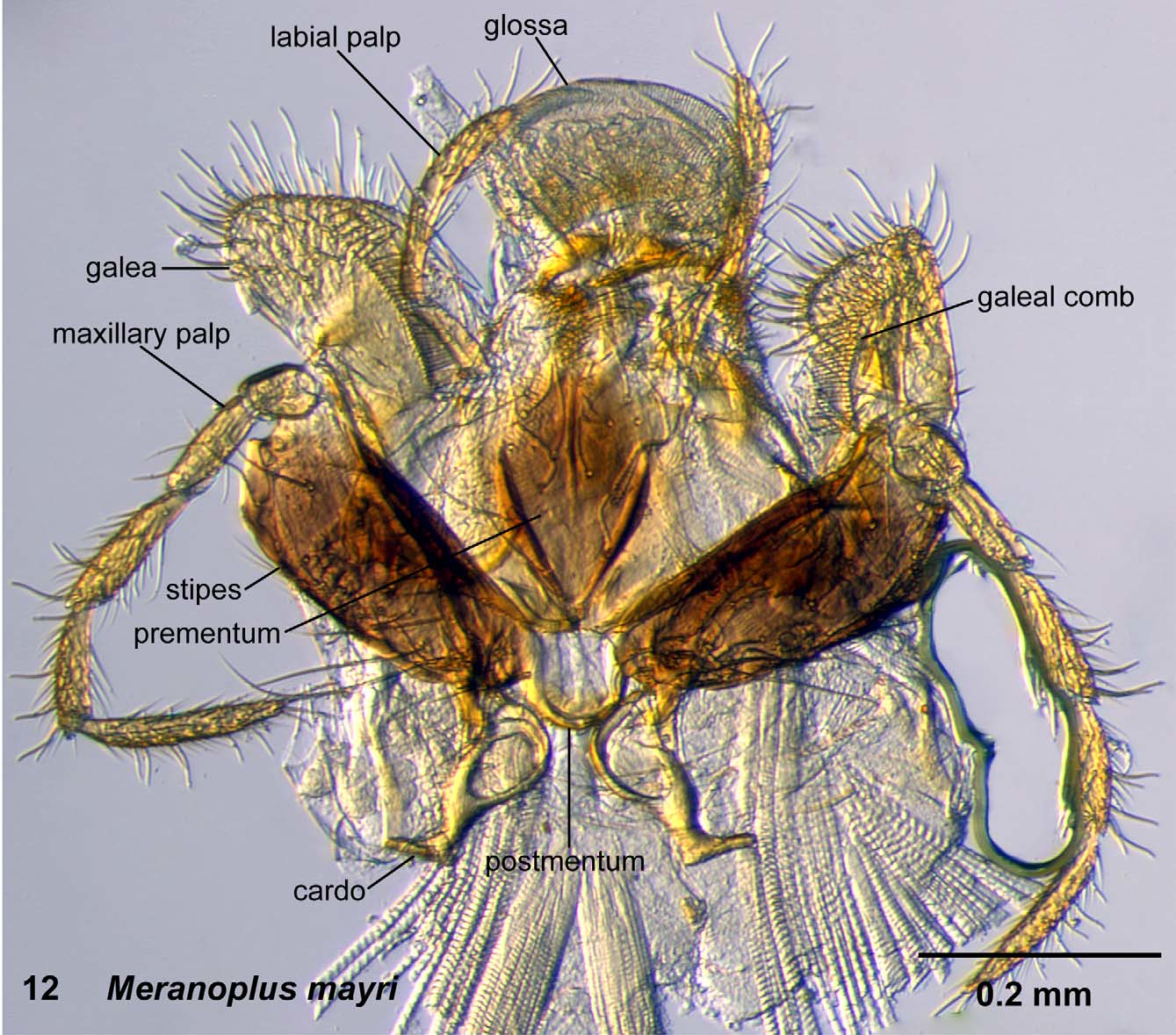
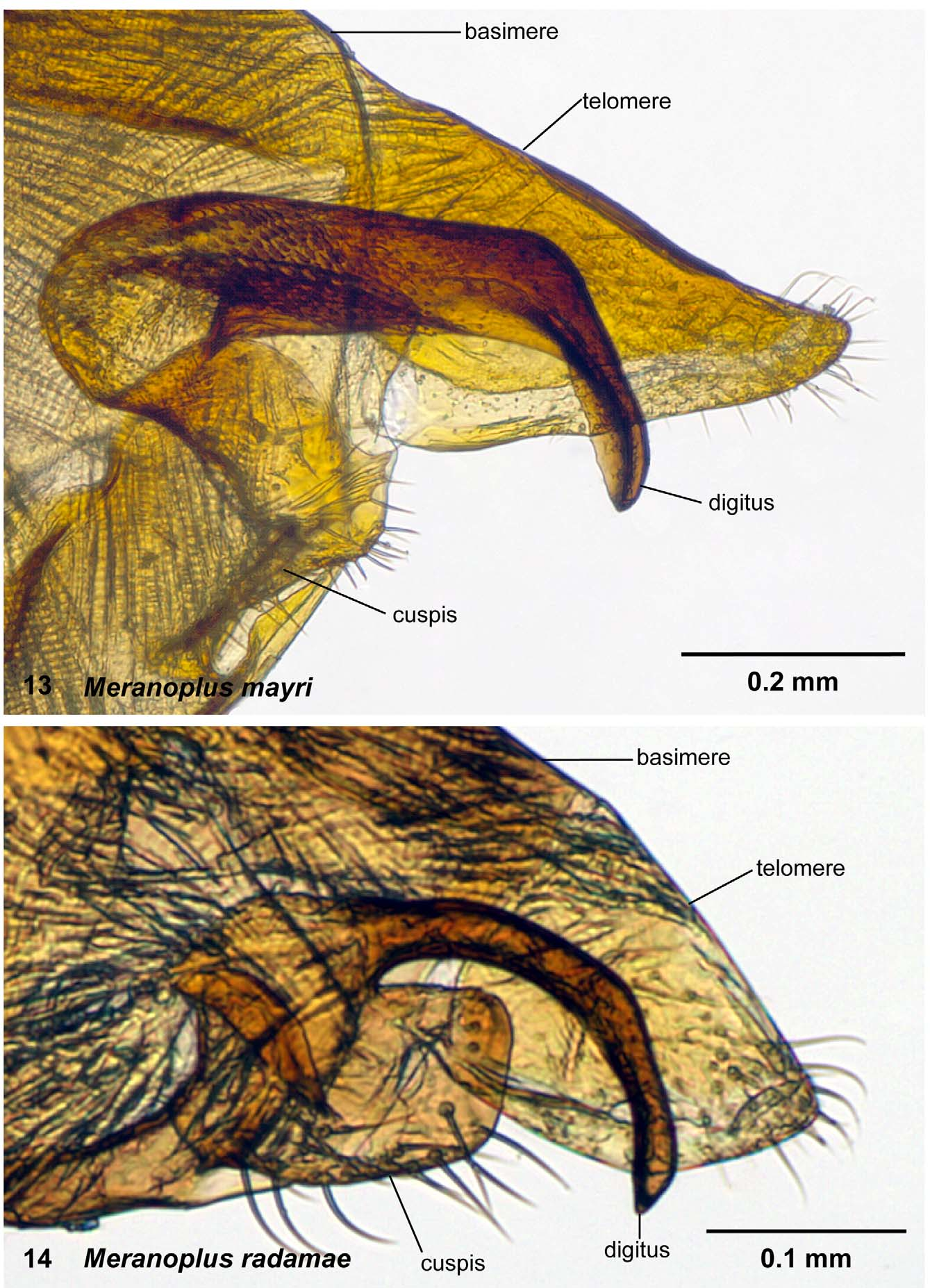
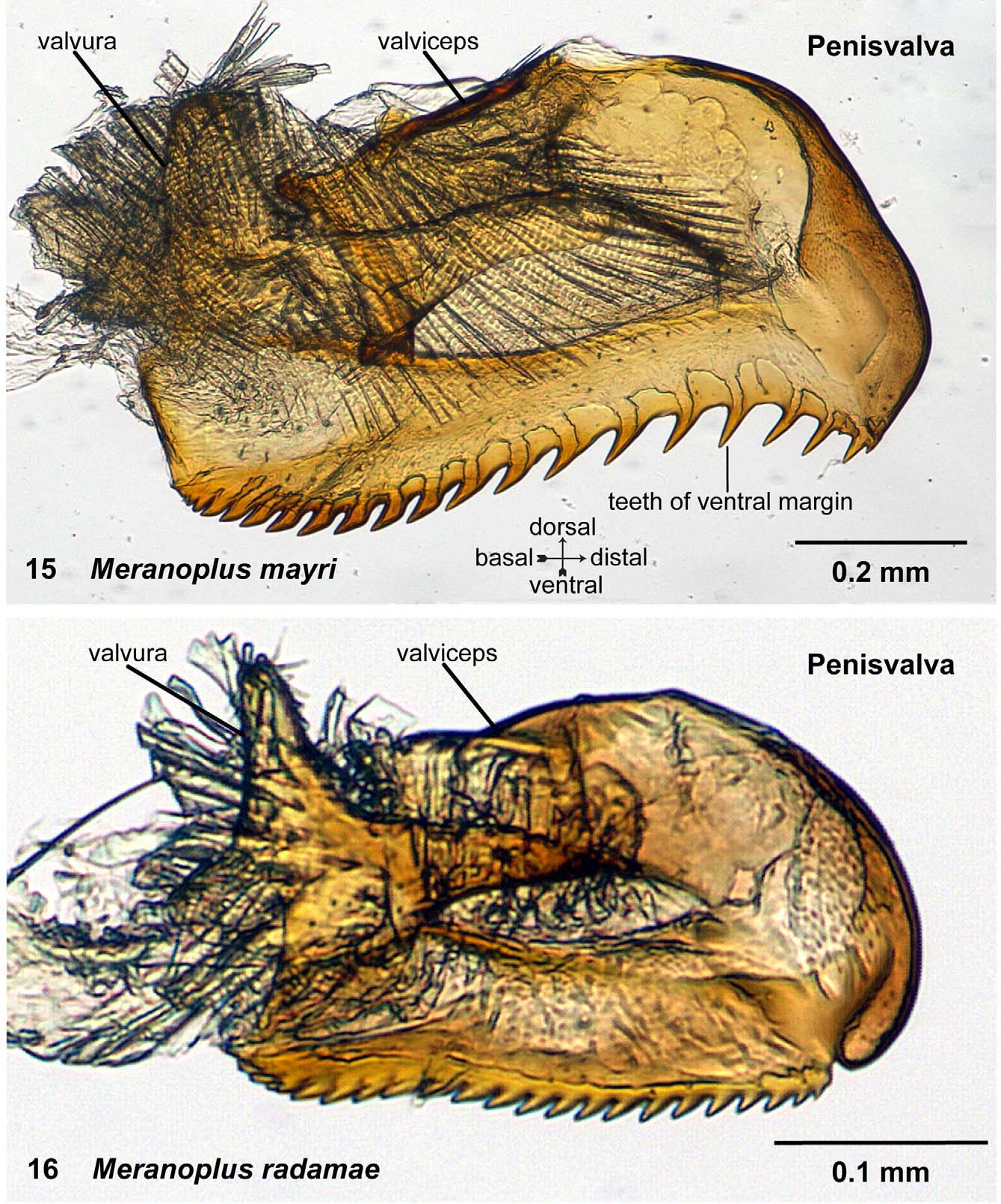
( Figs. 8, 11–13 View FIGURES 8 – 11 View FIGURE 12 View FIGURES 13 – 14 , 15 View FIGURES 15 – 16 , 19, 25, 31, 39–47, 65)
Meranoplus mayri Forel, 1910 a: 19 . Lectotype worker, here designated, MADAGASCAR: Toliara, Fort Dauphin, ( Sikora) (MHNG: CASENT0101230) [examined].
Description
Worker. HL 0.93–1.27, HW 0.98–1.41, HLA 0.34–0.54, CW 0.37–0.49, CDD 0.17–0.25, SL 0.74–1.04, EL 0.18–0.26, EW 0.15–0.19, PML 1.06–1.53, PWA 0.90–1.45, PWP 0.53–0.99, SPL 0.27–0.47, WL 1.04–1.58, PTL 0.18–0.35, PTH 0.43–0.61, PPL 0.24–0.40, PPH 0.39–0.58, ATW 1.03–1.77, ATL 1.09–1.82, CI 100.4–111.8, SI 69.0– 84.9, OMI 43.6–60.5, CDI 42.7–58.8, SEI 379–454, PMI 88.1–97.5, PWI 51.2–73.9, CS 0.9–1.3, EYE 30.0– 35.3 ( 50 measured).
Bicolored; head, mesosoma, petiole and postpetiole orange, metasoma piceous to black.
Head as broad as or broader than long (CI> 100). Mandibles striate. Face with numerous (> 20) parallel costae which extend from the posterior margin of the clypeus to the posterior margin of the head; a few lateral costae curve posteriorly to the eye and either end at the eye or the base of the mandibles. Frontal carinae produced over the antennal scrobe as flanges, and with rugose sculpture on the dorsal surface. Scrobal carina dwarfed by the frontal carina flange, sometimes reduced to near absence. Anterior margin of clypeus without lamina; lateral corners of middle portion of clypeus produced into two stout, widely set denticles (CDI> 40). Middle portion of clypeus shining, with strong costae. Eyes small (EYE < 36). Maximum eye length less than ¾ length of malar area (OMI < 62). Face covered with numerous erect setae of various lengths; longest setae about 2.5 times as long as eye, and somewhat more frequent; shortest setae about equal in length to the eye.
Promesonotal shield longer than broad, including the posterolateral spines (PMI < 99). Lateral margins of promesonotal shield produced into translucent flanges. Anterolateral corners acute to subacute. Lateral flanges produced into flat denticles past midlength; these medial denticles are set off from rest of margin by anterior and posterior emarginations. Posterolateral spines dorsoventrally flattened; always longer than their base; sometimes depressed below the plane of the promesonotal dorsum; often parallel, sometimes curved medially. Promesonotal shield with arcing costae: the costae begin on the posterolateral spines or lateral flanges and curve anteriorly, with their vertices anterior to the medial denticles. Promesontal shield with rugose sculpture on the lateral and posterior flanges as well as on the spines. Setae on promesonotal dorsum of similar composition to those of the face. Mesosomal pleurae without visible sutures. Lateral faces of mesosoma covered with numerous (> 15) longitudinal costae. Metapleural lobes weakly projecting posteriorly. Propodeal spines long (SPL mean 0.38); mediolaterally flattened; translucent. Posterior face of propodeum with strong to weak punctuation; with or without longitudinal costae.
Petiole without pedicel or lobe-like ventral process, but otherwise variable: with strong to weak anterolateral bulges; dorsal margin with well- to poorly-developed lamina; dorsolateral margins swept backward and produced into lobe-like laminae which may be long or short, rounded acute to obtuse, directed posterolaterally or dorsolaterally, with dense or dilute ventral pubescence. Postpetiole nodiform (PPI> 60). Dorsal face of postpetiole with strong rugose-areolate sculpture; lateral face strongly costate and rugose; posterior face rugose to areolate. Fourth abdominal tergum (ATIV) small (ATW/WL 1.20; ATL/WL < 1.23). ATIV with dense-punctate sculpture always in posterior half; anterior half grading from dense-punctate with radiating costae to smooth and shining with very weak costae. Setiferous punctures of ATIV surrounded by a circular area of shining, weak punctae. The majority of setae on ATIV longer than the maximum width of the metafemora; longest setae present around the base of abdominal tergum IV; setae decrease in length posteriorly.
Queen. HL 1.35–1.44, HW 1.48–1.58, HLA 0.48–0.54, CW 0.50–0.55, CDD 0.21–0.25, SL 0.96–1.07, EL 0.28–0.31, EW 0.23–0.24, SPL 0.19–0.25, WL 1.95–2.12, PTL 0.33–0.38, PTH 0.51–0.65, PPL 0.38–0.47, PPH 0.62–0.69, ATW 1.95–2.26, ATL 2.17–2.35, CI 105.8–113.3, SI 64.7–67.8, OMI 54.4–60.9, CDI 39.1–49.1, SEI 333–367, CS 1.4–1.5, EYE 34.6–37.1 ( 8 measured).
Bicolored; head, mesosoma, petiole and postpetiole orange, metasoma piceous to black.
Head broader than long (CI> 105). Mandibles striate. Face with numerous parallel costae, varying in rugosity, which extend from posterior margin of clypeus to posterior margin of head; lateralmost costae curving over eyes and extending to base of mandibles. Sculpture above the eyes costate to weakly rugose. Scrobal carina variable, never strong or bulging. Anterior margin of clypeus without lamina, rather with two strong, widely set, coneshaped denticles (CDI> 38). Middle portion of clypeus entirely costate; costae of varying rugosity. Eyes comparatively small (EYE < 38). Maximum length of eye less than ¾ as long as malar area (OMI 54–61). Scapes not notably short (SI 64–68). Setae on face erect and of various lengths.
Mesosoma longer than tall. Anterolateral corners of pronotum produced into well-developed denticles; dorsolateral margin produced into a distinct carina. Mesosomal dorsum porcate; ridges of varying rugosity sometimes anastomosing. Setae on dorsum of mesosoma of various lengths; longest on the pronotum and mesoscutellum. Lateral face of pronotum costate, with costae in dorsal third curving upward to join dorsolateral carina. Katepisternum costate, occasionally with a smooth patch in anterior portion. Anepisternum with strong costae which are widely set relative to katepisternal costae. Mesopleuron and lateral face of propodeum costate. Propodeal spines variably short to long (SPL 0.14–0.25). Procoxae with distinct anterolateral basal shoulder. Procoxae with raised sculpture. Wings as in Meranoplus male diagnosis. Forewing discal cell 1 ( d 1) with marked intrapopulation variation: d 1 longer than broad, or as long as broad; d 1 posterodistal corner may be acute or sub-perpendicular.
Petiole cuneate in profile; with anterior bulge in ventral half; without pedicel. Anterolateral corners swept back, with laminar lobe variably developed. Postpetiole generally longer than tall, although exceptions may occur (PPI 64–69 [ 49]). Sternal process of postpetiole well-developed. Dorsal face of postpetiole strongly areolaterugose; lateral face rugose-costate; posterior face rugose. Fourth abdominal tergum (ATIV) with sides convex in dorsal view. ATIV short (ATL/WL 1.16 – 1.09). Base of ATIV with weak to very strong dense-punctate sculpture; subparallel costae radiating from helcium strong to weak. Middle portion to posterior portion of ATIV always with dense-punctate sculpture; smooth around setiferous punctures. Majority of ATIV setae shorter than metafemora; setae longest at base of tergum.
Male. HL 0.75–0.92, HW 0.79–0.99, HLA 0.11–0.15, SL 0.23–0.30, EL 0.23–0.35, EW 0.23–0.28, WL 1.47–1.87, PTL 0.29–0.39 PTH 0.28–0.36, PPL 0.27–0.34, PPH 0.32–0.39, ATW 1.16–1.66, ATL 1.03–1.43, CI 105.3–112.6, SI 26.7–30.7, OMI 212–249, SEI 81–88, CS 0.8 –1.0, EYE 61.6–65.5 ( 8 measured).
Body black, abdominal segments IV–VII brown to black above, appendages light to dark brown.
Large (WL 1.5–1.9, CS 0.8 –1.0). Head broader than long (CI 105–113). Mandibles short and spatulate, otherwise variable: masticatory margin edentate, with one basal or apical tooth, or with two teeth; dentition sometimes variable between left and right mandibles of same specimen. Frontal carinae indistinct to obsolescent. In full face view, posterior margin of head raised above ocelli greater than distance between lateral ocelli. Head with fine areolate sculpture and variable costae: costae posterior to ocelli may be longitudinal or transverse. Scapes short (SI 27–31). Eyes comparatively small (EYE 62–66); about two-and-a-half to about two times as long as malar area (OMI 212–243). Ocelli about the size of antennal sockets. Setae of head set in umbilicate punctures. Majority of setae on body longer than eye-length, suberect to erect, sinuate.
Notauli distinct and set with foveae; may continue to posterior margin of scutum after converging. Parapsidal lines distinct, faintly impressed. All dorsal surfaces of mesosoma coarsely rugose, with umbilicate setiferous punctures which are especially strong anterolaterally on the scutum. Rugae on scutellum may be transverse or longitudinal. Mesopleuron roughened by evanescent longitudinal costae; anepisternum may be somewhat smooth and shining. Metapleuron and lateral face of propodeum costate. Posterior face of propodeum with curving costae. Wing venation as in Meranoplus male diagnosis.
Petiole and postpetiole shape variable (PTI 92–123, PPI 83–95). Petiole and postpetiole sessile; apex of petiolar node rounded; postpetiole subglobose. Petiolar sternum occasionally with setae. Post-petiolar sternum setose. Fourth abdominal tergum shining; generally with weak, fine areolate sculpture but occasionally smooth; setae set on nodules or in punctures. Petiole and post-petiolar sculpture variable, with or without costae or rugae; foveate. Fourth abdominal sternum subopaque, with fine areolation. Setae of fourth abdominal tergum set in simple punctures, which may be somewhat raised.
Foramen genitale constricted, diameter about ½ height of basal ring; basal ring broadening posteriorly; basimere about 1.33 times longer than tall in profile; weakly pigmented dorsally in posterior half; medioventral margin of basimere produced medially as a lamina; telomere base less than 0.5 times basimere height; volsella with an apicoventral denticle; setae of cuspis short, no longer than telomere setae; digitus broad, ribbonlike; apical third of digitus sharply bent ventrally at an angle somewhat greater than 90 °. Ventral half of penisvalva apex produced posteriorly beyond apicodorsal margin lateral view; lateral apicodorsal margin somewhat angulate in dorsal view; valvura short, stout: broad at base with apex sub-rectangular. Ventral margin of penisvalva sinuate: convex in basal half to concave in distal half. Penisvalva ventral margin with long, recurved teeth; width and distance between the penisvalvar teeth varies basally to apically, with broadest, shortest teeth basally, increasing in size and spacing toward apex; spaces between teeth bases about half height of each tooth in apical third.
Diagnosis
Worker. Each of the following characters is sufficient to uniquely identify this species in the Malagasy fauna: long posterolateral promesonotal spines; conelike clypeal denticles; longitudinally costate face and pleurae; concentric arcing costae on promesonotal shield; fourth abdominal tergum dense-punctate; head broader than long (CI> 100); malar space about twice as long as eye (OMI 44–61); clypeal denticles widely set (CDI> 40). The labrum of M. mayri is distinct from the labra of M. radamae and sylvarius (figs. 8–11). The labral lobes in M. mayri are evenly rounded distally, whereas those of M. radamae and sylvarius are evenly rounded apicolaterally and taper linearly to the midline.
Gyne. Each of the following characters is sufficient to uniquely identify this species in the Malagasy fauna: large (WL> 1.90); face longitudinally costate; head broader than long (CI> 102); eyes small (EYE < 39); eye length distinctly less than ¾ malar area length (OMI < 61).
Male. The large size (WL 1.6–1.9) and raised posterior margin of the head uniquely identify this species in the Malagasy fauna. Diagnosis is supported by the following characters: umbilicate setiferous punctures present on head and mesosomal dorsum; eyes comparatively small (EYE 62–66); eyes less than 2.5 times as long as the malar area (OMI 212–243); posteroventral apex of penisvalva produced beyond posterodorsal margin; penisvalva without apical lobe.
Comments
Meranoplus mayri is distributed throughout the drier regions of Madagascar from the Southwestern region near P.N. Andohahela all the way north into the Mahajanga province. The elevational range of M. mayri is 20–1345 m. This species displays subtle variation in morphometric and most sculptural characters across its range except for the sculpture of the base of abdominal tergum IV. This character varies from extremely smooth and shining in the southwest to strongly, dense-punctate and costate along the western edge of the High Plateau. Intergrades are common, however, occurring all along the western coast and into the High Plateau. Both smooth and punctate specimens may be found at the same locales, including Ampotoampoto, Ejada, Tsihombe and Ambinanitelo. The variation of this character indicates that although the two extremes are reproductively isolated by distance and geography, but are otherwise linked across their range by intermediate populations.
Unfortunately, as with most of the diversity of Meranoplus , nothing is known about the behavior or ecology of M. mayri except that its ground nests may be found in urban gardens, grasslands, and deciduous and spiny forests. This is the most frequently collected Malagasy Meranoplus , with numerous specimens captured in pitfalls, malaise traps, and hand collections. Although few collections have been made of this species in the High Plateau region, it is predicted that they may be found there as well.
Material examined
MADAGASCAR: Antananarivo, Kaloy, 18 ° 35.47 ’ S, 47 ° 39.19 ’ E, 1338 m, grassland, 27 Apr 2007 ( B.L. Fisher et al.); Antananarivo, Tan Morafeno, 15 Dec 1991 ( A. Pauly); Fianarantsoa, P.N. Isalo, Ampotoampoto, 22.62803 ° S, 45.18843 ° E, 919 m, savanna woodland, coll’n code ARA0125, 24–28 Feb 2010 ( A. Ravelomanana); Fianarantsoa, P.N. Isalo, Ampotoampoto, 22.62935 ° S, 45.19120 ° E, 923 m, savanna woodland, coll’n code ARA400, 27– 28 Feb 2010 ( A. Ravelomanana); Tuléar, Andohehala N.P., Ihazofotsy, 24 ° 49.85 ’ S, 46 ° 32.17 ’ E, 60 m, transition between spiny and dry forests, coll’n code MA-02- 21 -06, 5 Jan 2003 ( Irwin et al.); Fianarantsoa, P.N. Isalo, Isalo, 22.61476 ° S, 45.31304 ° E, 867 m, Bismarckia woodland, coll’n code ARA314, 25Feb 2010 ( A. Ravelomanana); Fianarantsoa, P.N. Isalo, Isalo, 22.61594 ° S, 45.31084 ° E, 870 m, Bismarckia woodland, coll’n code ARA305, 24– 25 Feb 2010 ( A. Ravelomanana); Fianarantsoa, Itremo, Ampangabe, 20.61372 ° S, 46.60799 ° E, 1449 m, savanna grassland, coll’n code ARA877, 22– 24 Mar 2010 ( A. Ravelomanana); Mahajanga, P.N. Ampijoroa, 46 ° 19.16 ’ S, 46 ° 48.80 ’ E, 6 m, coll’n code MG- 25 -49, 16– 27 Apr 2005 ( Rin’Ha, Irwin); Toliara, Amboasary, 25 °02.33’ S, 46 ° 23.01 ’ E, 25 m, urban garden, coll’n codes BLF 15906, BLF 15915 and BLF15918, 9Dec 2006 ( B.L. Fisher et al.); Toliara, Andohehala NP, 24 ° 56.21 ’ S, 46 ° 37.60 ’ E, 174 m, transition forest, coll’n codes MG. 20.56, MG. 20.27, 31 May– 10 Jun2003, 6- 18 Mar 2004 ( Rin’Ha, Irwin); Toliara, P.N. Andohehala, Manantalinjo 7.6 km 99 ° E Hazofotsy, 24 ° 49 ’S, 46 ° 37 ’ E, 150 m, under stone in spiny forest/thicket, coll’n codes BLF 4863 and BLF41884, 12– 16 Jan 2002 ( B.L. Fisher et al.); ground nest in spiny forest/thicket, coll’n code BLF5303, 28Jan– 1 Feb 2002 ( B.L. Fisher et al.); Toliara, P.N. Andohehala, Manatalinjo, 7.6 km 99 ° E Hazofotsy, 24 ° 49 ’ S, 46 ° 37 ’ E, 160 m, ground nest in spiny forest/thicket, coll’n codes BLF 4811, BLF4884, 12– 16 Jan 2002 ( B.L. Fisher et al.); Toliara, Behara, 24 ° 52.42 ’S, 46 ° 23.86 ’E, 85 m, spiny forest/thicket, coll’n codes BLF 15886 and BLF15895, 9Jul 2006 ( B.L. Fisher et al.); Toliara, Berenty Special Reserve, 25 °01.26’ S, 46 ° 18.33 ’ E, 36 m, spiny forest, coll’n code MG- 22 A, 15–29 Apr 2004 ( Rin’Ha, Irwin); Toliara, Rés. Berenty, Forêt Anjapolo, 21.4 km 325 ° NW Amboasary, 24 ° 56 ’ S, 46 ° 13 ’ E, 65 m, ground nest in spiny forest/thicket, coll’n codes BLF 5460 and BLF5490, 7Feb 2002 ( B.L. Fisher et al.); Toliara, Rés. Berenty, Forêt Bealoka, 14.6 km 329 ° NNW Amboasary, 24 ° 57 ’ S, 46 ° 16 ’ E, 35 m, ground nest “gallery forest”, coll’n code BLF5382, 3– 8 Feb 2002 ( B.L. Fisher et al.); Toliara, Ampanihy, 24 ° 41.62 ’ S, 44 ° 44.82 ’E, 250 m, urban/garden, coll’n codes BLF 15975, BLF 15982, BLF15991, 10Dec 2006 ( B.L. Fisher et al.); Toliara, Rés. Berenty, Forêt Malaza, 8.6 km 314 ° NW Amboasary, 25 °00’ S, 46 ° 18 ’ E, 40 m, “gallery forest”, coll’n code BLF5419, 6Feb 2002 ( B.L. Fisher et al.); Toliara, Betioky, 23 ° 43.27 ’ S, 44 ° 22.81 ’ E, 270 m, urban/garden, coll’n code BLF16035, 11Dec 2006 ( B.L. Fisher et al.); Toliara, Rés. Cap Sainte Marie, 14.9 km 261 ° W Marovato, 25 ° 36 ’ S, 45 °09’ E, 160 m, ground nest in spiny forest/thicket, coll’n codes BLF 5695 and BLF5748, 13– 19 Feb 2002, ( B.L. Fisher et al.); Toliara, Col du Manangotry, 24 ° 45 ’ S, 16 ° 48 ’ E, 600 m, coll’n code BLF601, 6Jul 1992 ( B.L. Fisher); Toliara, Ehazoara Conyon, 26 km E Betioky, 23 ° 41 ’ S, 44 ° 38 ’ E, 175 m, ground forager in tropical dry forest, coll’n code BLF 1510 -1, 27Apr 1997 ( B.L. Fisher); Toliara, Ejada, 24 ° 21.03 ’ S, 44 ° 30.96 ’ E, 250 m, urban/garden, coll’n codes BLF 15999, BLF 16009, BLF 16011, BLF 16018, BLF16025, 10Dec 2006 ( B.L. Fisher et al.); Toliara, P.N. Kirindy Mite, 16.3 km 127 ° SE Belo sur Mer, 20 ° 48 ’S, 44 °09’E, 80 m, ground nest tropical dry forest, coll’n codes BLF 4744, BLF 4727, BLF4753, 6– 10 Dec 2001 ( B.L. Fisher et al.); Toliara, Kirindy, 15.5 km 64 ° ENE Marofandilia, 20 °03’S, 44 ° 40 ’E, 100 m, ground nest tropical dry forest, coll’n codes BLF 4607 and BLF4613, 28Nov– 3 Dec 2001 ( B.L. Fisher et al.); Toliara, 4 km N Isaka-Ivondro, 24 ° 46 ’S, 46 ° 52 ’E, 180 m, ground foragers roadside, coll’n code PSW 11804 -1, 3Feb 1993 ( P.S. Wa rd); Toliara, S.F. Mandena, 8.4 km NNE 30 ° Tolagnaro, 24 ° 57.1 ’S, 47 °00.1’E, 20 m, ground forest “littoral rainforest”, coll’n code BLF2050, 20Nov 1998 ( B.L. Fisher et al.); Toliara, Mahafaly Plateau, 6.2 km 74 ° ENE Itampolo, 24 ° 19 ’S, 43 ° 69 ’E, 80 m, ground nest in spiny forest/thicket, coll’n code BLF5845, 21– 25 Feb 2002 ( B.L. Fisher et al.); Toliara, Forêt Mahavelo, Isantoria Riv., 5.2 km 44 ° NE Ifotaka, 24 ° 46 ’ S, 46 °09’ E, 110 m, ground nest in spiny forest/thicket, 28 Jan– 1 Feb 2002 ( B.L. Fisher et al.); Toliara, Forét Mandena, 24 ° 57.16 ’S, 47 °00.15’E, 20 m, littoral rainforest, coll’n code BLF15666, 5Dec 2006 ( B.L. Fisher et al.); Toliara, 48 km ENE Morondava, 20 °04’S, 44 ° 39 ’E, 30 m, tropical dry forest, 4–6 Jan 1991 ( D.M. Olsen); Toliara, Tsihombe, 25 ° 19.10 ’S, 45 ° 29.02 ’E, 30 m, coll’n codes BLF 15951, BLF15959, 10Dec 2006 ( B.L. Fisher et al.); Toliara, P.N. Tsimanampetsotsa, Bemananateza 23.0 km 131 °SE Behaloka, 24 °00’S, 43 ° 53 ’ E, 90 m, ground nest spiny forest/ thicket, coll’n codes BLF 6265, BLF 6268, BLF6280, 22– 26 Mar 2006 ( B.L. Fisher et al.); Toliara, Forêt Vohidava, 24 ° 14.446 S, 46 ° 17.27 ’ E, 500 m, dry forest, coll’n code BLF15851, 6– 8 Dec 2006 ( B.L. Fisher et al.); Tuléar, P.N. Andohehala, Tsimela, 24 ° 56.21 ’ S, 46 ° 37.60 ’ E, 177 m, transition forest, coll’n code MG- 20 -52, 15- 28 Jan 2004 ( Rin’Ha, Irwin); Tuléar, Andohehala, N.P., Tsimelahy, 24 ° 56.21 ’ S, 46 ° 37.60 ’ E, 180 m, coll’n code MA-02- 20 -16, 15– 26 Feb 2001 ( M. Irwin et al.); Tuléar, Berenty Special Reserve, 25 °00.40’ S, 46 ° 18.20 ’ E, “gallery forest”, 27 Dec2007, 7– 17 Jan2003, 24Mar– 3 Apr 2003 ( Rin’Ha, Irwin); Tuléar, Reserve Berenty, 25 °01’ S, 46 ° 18 ’ E, 25 m, ground foragers in tropical dry forest, coll’n code BLF 603 -1, 10Dec 1992 ( B.L. Fisher).
No known copyright restrictions apply. See Agosti, D., Egloff, W., 2009. Taxonomic information exchange and copyright: the Plazi approach. BMC Research Notes 2009, 2:53 for further explanation.