
Trachecymbius, Haddad & Lyle, 2024
|
publication ID |
https://doi.org/10.11646/zootaxa.5399.5.1 |
|
publication LSID |
lsid:zoobank.org:pub:ED0CE93C-3235-4DEE-951B-A46CBD3D6AF9 |
|
DOI |
https://doi.org/10.5281/zenodo.10520074 |
|
persistent identifier |
https://treatment.plazi.org/id/633387D8-9D50-FFE9-FF3A-AF6AC3C5FEA7 |
|
treatment provided by |
Plazi |
|
scientific name |
Trachecymbius |
| status |
gen. nov. |
Key to the genus Trachecymbius gen. nov.
1 Males (♁ of T. bosselaersi sp. nov. and T. umbella sp. nov. unknown)........................................... 2
− Females............................................................................................. 4
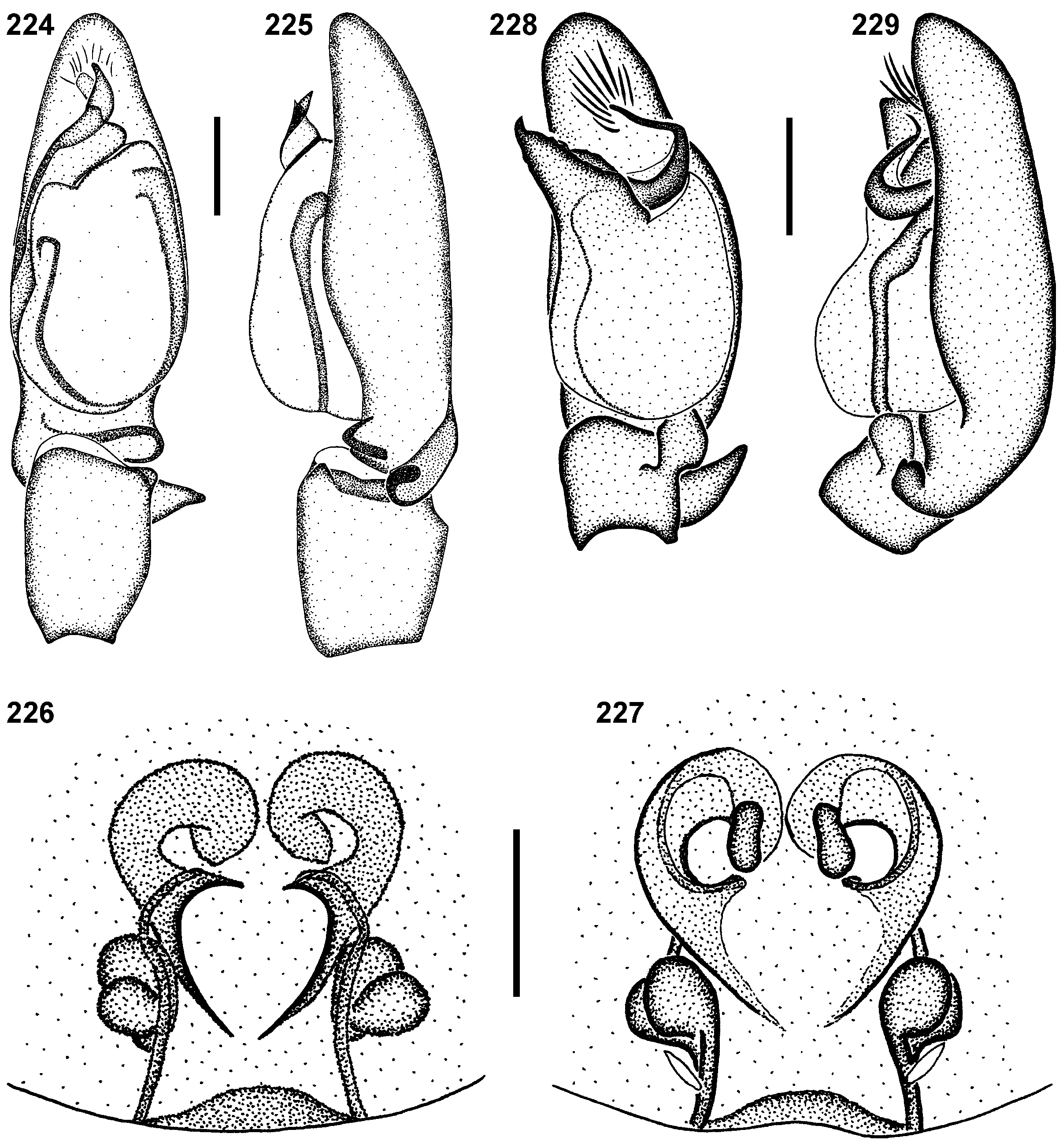
2 RTA very short and inconspicuous ( Figs 224, 225 View FIGURES 224–229 )................................................ T. felis sp. nov.
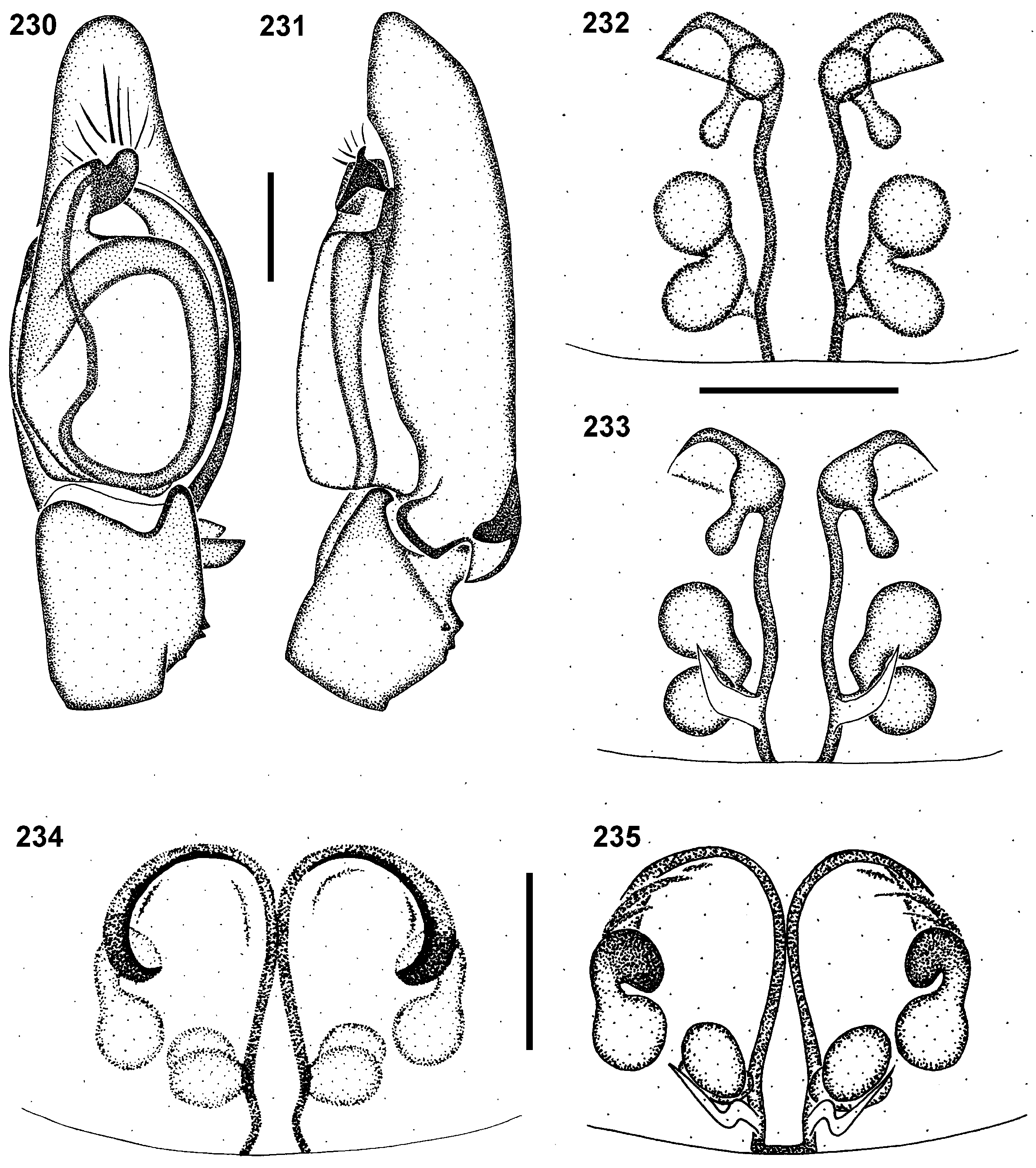
− RTA distinct, at least ¼ tibia length ( Figs 228 View FIGURES 224–229 , 230 View FIGURES 230–235 ).......................................................... 3
3 RTA thumb-like, with rounded tip; tegulum with massive subtriangular prolateral apophysis; embolus narrow, long, with tip directed prodistally ( Figs 228, 229 View FIGURES 224–229 )...................................................... T. peterwebbi sp. nov.
− RTA triangular, with bent tip in lateral view; tegular apophysis absent; embolus short, stout, with rounded tip directed retrodistally ( Figs 230, 231 View FIGURES 230–235 ).......................................................................... T. tyume sp. nov.
4 Copulatory openings near centre of epigyne in longitudinal curved ridges, forming heart-shaped atrium centrally ( Fig. 226 View FIGURES 224–229 ).......................................................................................... T. felis sp. nov.
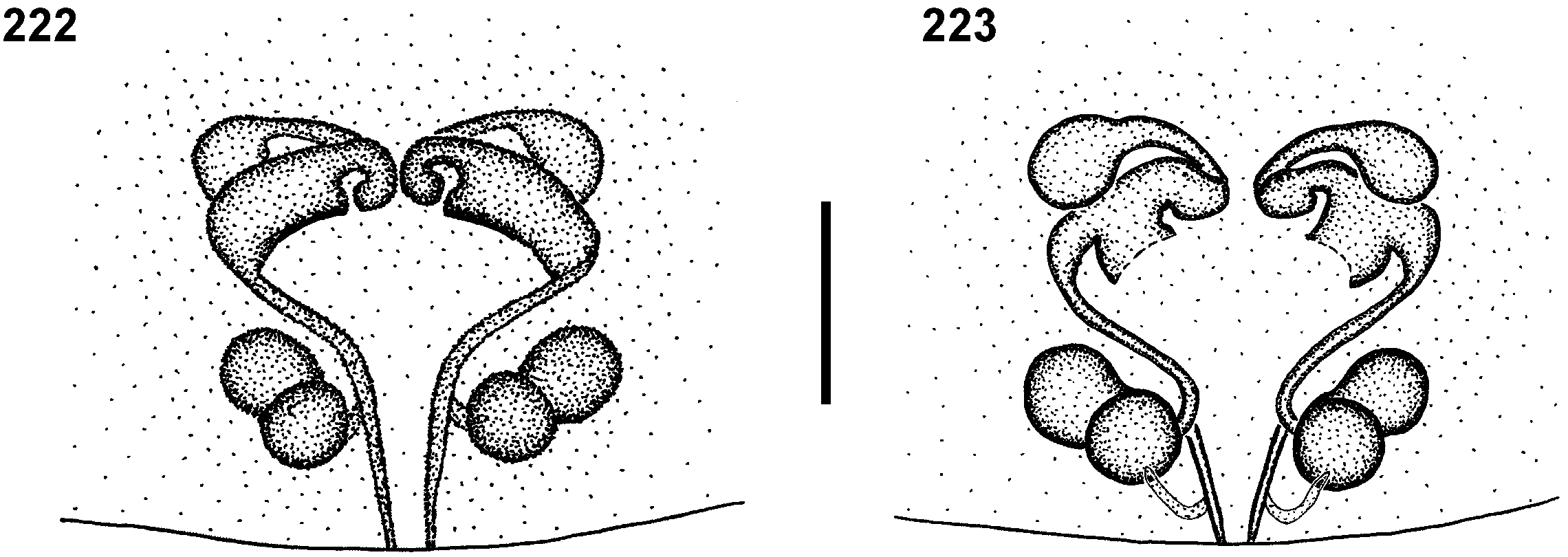
− Copulatory openings positioned anteriorly or anterolaterally, in recurved ridges ( Figs 222 View FIGURES 222–223 , 232, 234 View FIGURES 230–235 )................... 5
5 Copulatory openings situated in broad, semicircular ridges, with long copulatory ducts leading to lateral ST II near midpoint of epigyne, proximate to ST I ( Fig. 234 View FIGURES 230–235 )....................................................... T. umbella sp. nov.
− Copulatory openings situated in relatively narrow ridges, with short copulatory ducts leading to ST II anteriorly in epigyne; ST I and II widely separated ( Figs 222 View FIGURES 222–223 , 232 View FIGURES 230–235 )................................................................... 6
6 ST II situated anterolaterally; connecting ducts of spermathecae originating anterolaterally, converging towards posterior ( Figs 222, 223 View FIGURES 222–223 )........................................................................... T. bosselaersi sp. nov.
− ST II situated anteromedially; connecting ducts of spermathecae almost parallel, running either side of midline of epigyne ( Figs 232, 233 View FIGURES 230–235 )............................................................................... T. tyume sp. nov.
No known copyright restrictions apply. See Agosti, D., Egloff, W., 2009. Taxonomic information exchange and copyright: the Plazi approach. BMC Research Notes 2009, 2:53 for further explanation.
|
Kingdom |
|
|
Phylum |
|
|
Class |
|
|
Order |
|
|
Family |