
Dolichandra quadrivalvis ( Jacquin 1809: 37 ) Lohmann (2008: 273)
|
publication ID |
https://doi.org/10.11646/phytotaxa.570.2.4 |
|
DOI |
https://doi.org/10.5281/zenodo.7256641 |
|
persistent identifier |
https://treatment.plazi.org/id/03EDCC69-EB59-EC41-FF38-0AD444CEFD98 |
|
treatment provided by |
Plazi |
|
scientific name |
Dolichandra quadrivalvis ( Jacquin 1809: 37 ) Lohmann (2008: 273) |
| status |
|
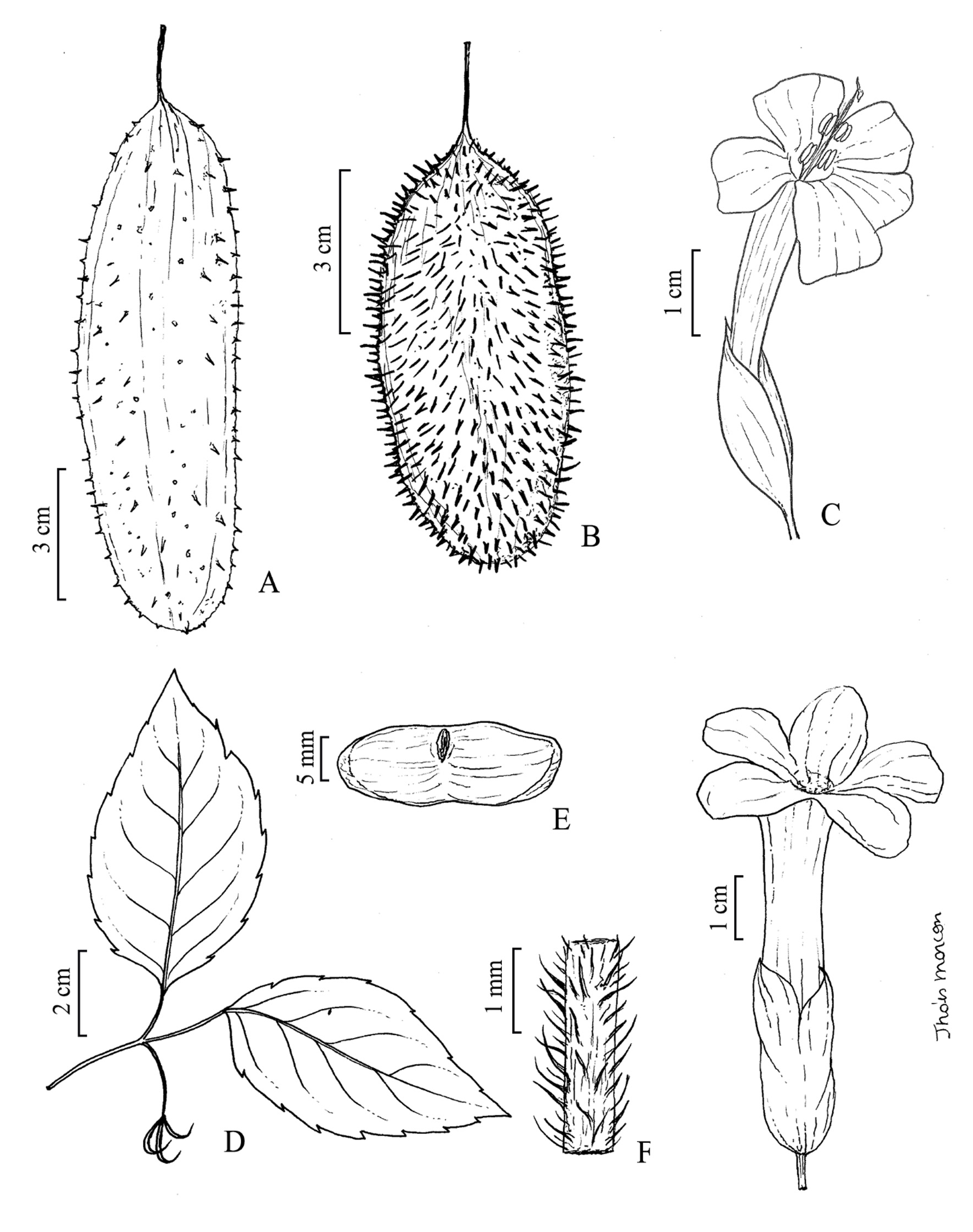
4.4. Dolichandra quadrivalvis ( Jacquin 1809: 37) Lohmann (2008: 273) ( Fig. 4 a–b View FIGURE 4 ).
Diagnosis:— Dolichandra quadrivalvis can be recognized by the oblong fruit ( vs. linear fruits in all other Dolichandra ).
Reproductive Period:— Flowers were collected in May and August, no fruiting data.
Distribution and Habitat:— It occurs from México to Uruguay, and throughout Brazil ( Lohmann 2010, Lohmann & Taylor 2014, Fonseca et al. 2017). Within the study area, it was registered in Céu Azul and Capanema , on dry locations such as the Céu Azul-Serranópolis do Iguaçu unpaved road, and on the Iguaçu river bank.
Selected Specimens Examined:— BRAZIL. Paraná, Parque Nacional do Iguaçu: Capanema , margem do Rio Iguaçu , 25°34’25.9”S, 54°03’29.9”W, 03 March 2019, Rauber 375 ( UNOP!) GoogleMaps ; Céu Azul, borda do Parque , 25°12’26.1”S, 53°51’57.7”W, 21 August 2015, Caxambu 6813 ( HCF!, MBM!, DVPR) GoogleMaps .
No known copyright restrictions apply. See Agosti, D., Egloff, W., 2009. Taxonomic information exchange and copyright: the Plazi approach. BMC Research Notes 2009, 2:53 for further explanation.
|
Kingdom |
|
|
Phylum |
|
|
Class |
|
|
Order |
|
|
Family |
|
|
Genus |