
Polyergus longicornis, Trager, James C., 2013
|
publication ID |
https://dx.doi.org/10.11646/zootaxa.3722.4.5 |
|
publication LSID |
lsid:zoobank.org:pub:C1F59CA8-0F0E-471B-9B2D-26980A002511 |
|
persistent identifier |
https://treatment.plazi.org/id/03DBDC46-FFA0-FF83-4BBE-FBE0FD8A6B55 |
|
treatment provided by |
Plazi |
|
scientific name |
Polyergus longicornis |
| status |
new status |
Polyergus longicornis new status
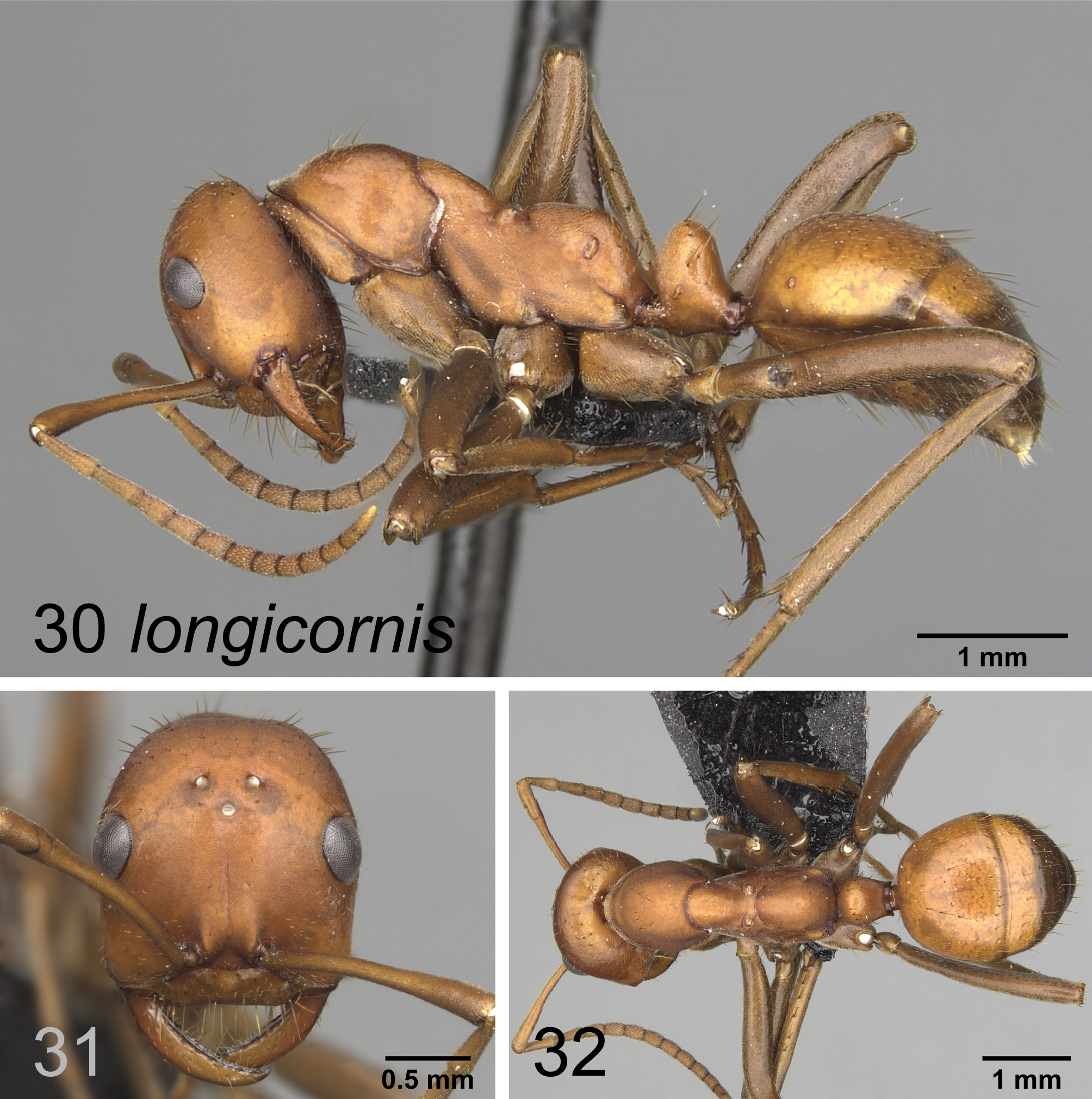
Figures 30, 31, 32 View FIGURES 30 – 32
Polyergus lucidus longicornis M. R. Smith 1947: 155 . Syntype workers: USA, SOUTH CAROLINA, Florence [USNM, 57661] (images examined). New status.
Types not measured.
Measurements (N= 18) HL 1.60–1.80 ( 1.71), HW 1.52–1.72 ( 1.62), SL 1.67–1.89 ( 1.77), ½ VeM 13–22 ( 17.78), ½ PnM 0–9 ( 3.78), WL 2.52–2.88 ( 2.73), GL 2.08–2.68 ( 2.34), HFL 2.22–2.56 ( 240), CI 91–99 ( 95), SI 101–117 ( 109), HFI 139–158 ( 149), FSI 130–144 ( 136), LI 4.16–4.68 ( 4.44), TL 6.44–7.32 ( 6.78).
Worker description. Head truncate-obovate to narrowly subhexagonal, generally more strongly tapering behind than in front of the eyes, HL> HW; with conspicuous and abundant vertex pilosity of 20–40 erect macrosetae; scapes at least equaling to notably longer than head, always surpassing vertex corners, gradually thickening apically, not notably clavate; pronotum with ( 3) 6–12 ( 18) erect macrosetae; mesonotal profile flat or very weakly convex for most of its length; propodeal profile evenly rounded, its dorsal and posterior faces indistinct; petiole a little narrower than propodeum, with convex sides, these convergent dorsad; petiolar dorsum convex, not emarginate; petiole in profile tapering and usually slightly recurved dorsad; first tergite very sparsely pubescent or completely lacking pubescence; first tergite pilosity sparse, usually a few on the anterior half, but these often deciduous; the macrosetae weakly flexuous.
Head matte; mesosoma matte; gaster weakly matte.
Color red with infuscation of appendages and posterior portions of tergites.
Discussion. P. longicornis is most likely to be confused with ruber and especially sanwaldi . Polyergus longicornis is distinguished from the largely sympatric ruber by its more abundant vertex pilosity, ½ VeM 13 + vs. 12 or less, nearly uniformly matte mesosoma and cephalic integument, and parasitism of F. do l o s a rather than F. biophilica . Polyergus longicornis is distinguished from the allopatric, more northern P. sanwaldi by its proportionally longer scapes and legs, and its slightly narrower head ( Fig. 2 View FIGURE 2 ).
Etymology. Smith coined the name of this ant species as an adjective, from Latin “longus” + “cornus”, referring to its long scapes.
Natural history. Polyergus longicornis is a southeastern species, known from the Carolinas and Georgia, west to Mississippi. It is found in the open pinelands and oak-pine woodlands on sandy soils with host populations of F. dolosa .
Distribution of studied specimens. FLORIDA Leon Co. Apalachicola Nat’l For. Rd. 307. Stand 246 June 2004 JR King Colony Series, Pine Flatwoods (JCTC); MISSISSIPPI Oktibbeha Co. Osborn 33 o 30 ’ 41 ”N 88 o 44 ’08”W 19 June 2003 J. G. Hill (MEM); MISSISSIPPI Pontetoc Co. Natchez Trace, mi. 247.5. 34 o05’ 49 ”N 88 o 51 ’ 38 ”W 23 June 2003 JA MacGown (MEM); MISSISSIPPI Winston Co. Tombigbee Nat’l Forest 33 o 2 ’ 30 ”N 89 o04’ 32 ”W. 10 July 2003 JA MacGown (MEM); NORTH CAROLINA Mecklenburg Co. Davidson 6 -VI- 39 CS Brimley (NCSU); NORTH CAROLINA Staley 15 -VIII- 1968 DL Wray (NCSU); NORTH CAROLINA Moore Co. Robbins in yard 7 -VII- 1985 Morris (NCSU); SOUTH CAROLINA McCormick Co. Baker Cr. St. Pk. Open pineland 28 June 1986 C Johnson (JCT).

No known copyright restrictions apply. See Agosti, D., Egloff, W., 2009. Taxonomic information exchange and copyright: the Plazi approach. BMC Research Notes 2009, 2:53 for further explanation.