
Pholcus yangi, Zhang & Zhu, 2009
|
publication ID |
https://doi.org/10.11646/zootaxa.2235.1.2 |
|
DOI |
https://doi.org/10.5281/zenodo.5327752 |
|
persistent identifier |
https://treatment.plazi.org/id/03D88781-FFAF-FFE0-FF15-497EFD51FD9E |
|
treatment provided by |
Felipe |
|
scientific name |
Pholcus yangi |
| status |
sp. nov. |
Pholcus yangi sp. nov.
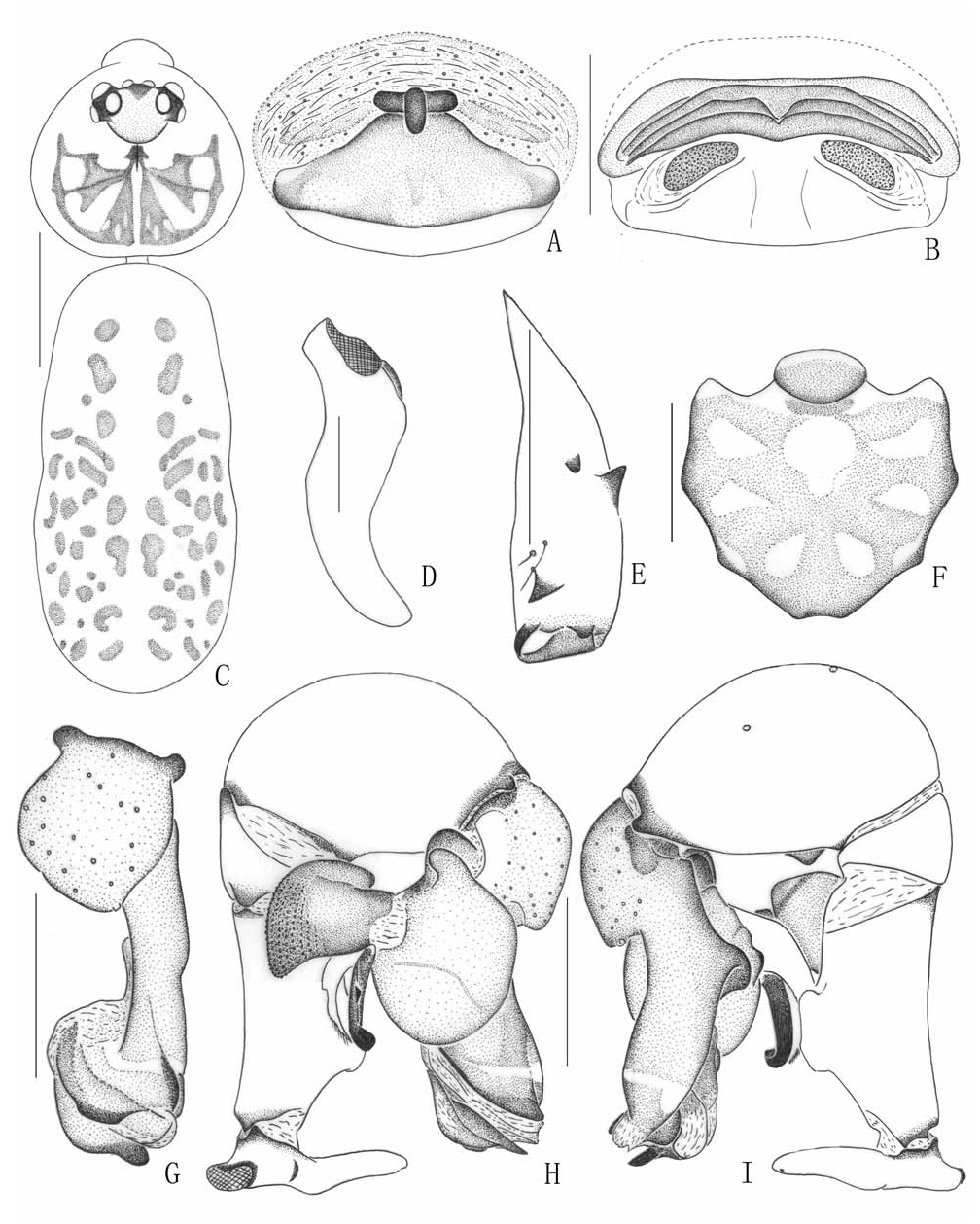
( Figs. 58–59)
Types. Male holotype, 13♂, 12♀ paratypes, CHINA: Yunnan Province, Binchuan County, Mt. Jizu [ 25°54’N, 100°18’E], March 17, 2003, leg. Z. Z. Yang ( MHBU) GoogleMaps .
Diagnosis. Among its near Pholcus relatives (see the remark of P. clavatus ), this species is very similar to P. shangrila sp. nov. and P. kunming sp. nov. in the shapes of the palpal bulb, all with branched appendices ( Figs. 23H, 43H View FIGURE 43 and 58H) and teat-shaped epigynal apophyses ( Figs. 23A, 43A View FIGURE 43 and 58A). It can be distinguished from these two species by the shape of the procursus ( Figs. 58G–I), also from P. kunming sp. nov. by the small ventral apophysis of the trochanter ( Figs. 58D, H–I), and also from P. shangrila sp. nov. by the cephalic region with brown slender central marks ( Fig. 58C) and the shorter ventral apophysis of the trochanter ( Figs. 58D, H–I).
Etymology. Named in honour of the collector of the type material, Zizhong Yang.
Description. Male ( holotype): total body length 4.4: cephalothorax 1.3 long, 1.4 wide; abdomen 3.2 long, 1.4 wide. Leg I: 36.2 (9.0+0.8+8.7+15.5+2.2), tibia II: 5.8, tibia III: 3.5, tibia IV: 4.6; tibia I L/D: 54. Prosoma shape as in Fig. 58C. Carapace short, broad and almost circular, ochre, with pair of brown marks broadly connecting to ocular area. Cephalic region raised, with brown longitudinal stripe centrally, ocular area dark yellow. Clypeus 0.42, dark ochre, with marks. Distance AME–AME 0.07. Diameter AME 0.08, ALE 0.14, PME 0.12, PLE 0.13. Chelicerae as in Figs. 58E and 59D, with pair of black apophyses distally, pair of unsclerotized thumb-shaped apophyses proximolaterally, and pair of unsclerotized round apophyses proximocentrally and two pairs of bristles ( Figs. 59D–E). Labium light yellow. Endites gray. Sternum almost dark brown, with irregular yellow patches and slightly yellow margin as in Fig. 58F. Femora, patellae and tibiae ochre, with dark rings, metatarsi and tarsi brown. Abdomen cylindrical, pale ochre, dorsum with many small brown patterns as in Fig. 58C. Venter pale brown. Male gonopore with four epiandrous spigots as in Fig. 59F. ALS with six piriform gland spigots as in Fig. 59I. Palps as in Figs. 58H–I and 59G, bulb with a large uncus, appendix with a proximal branch. Procursus as in Fig. 58G. Tarsal organ capsulate as in Fig. 59C.
Variation. Tibia I in ten male paratypes ( three males missing Leg I): 8.2–8.8 (mean 8.5). Body length in 13 male paratypes: 4.2–4.5.
Female: in general very similar to male. Total length of bodies 4.0–5.1. A paratype measured (Mt. Jizu), total length 4.1: cephalothorax 1.2 long, 1.3 wide; abdomen 2.9 long, 1.4 wide. Tibia I: 5.5. Distance AME–AME 0.05. Diameter AME 0.08, ALE 0.13, PME 0.11, PLE 0.12. Tip of female palp with capsulate tarsal organ ( Fig. 59A). Epigynum roughly rectangular as in Figs. 58A and 59B, with a small knob-shaped apophysis on the top. Dorsal view as in Fig. 58B, with a rainbow-shaped sclerotized arch anteriorly and a pair of oval pore plates posteriorly.
Distribution. Known from type locality only.
No known copyright restrictions apply. See Agosti, D., Egloff, W., 2009. Taxonomic information exchange and copyright: the Plazi approach. BMC Research Notes 2009, 2:53 for further explanation.