
Rhinolophus pusillus Temminck, 1834 Rhinolophus sinicus K. Andersen, 1905 Rhinolophus stheno K. Andersen, 1905
|
publication ID |
https://doi.org/10.3161/150811009X465703 |
|
persistent identifier |
https://treatment.plazi.org/id/03AF87D3-C436-B542-FCEA-8738FE35BA22 |
|
treatment provided by |
Valdenar |
|
scientific name |
Rhinolophus pusillus Temminck, 1834 Rhinolophus sinicus K. Andersen, 1905 Rhinolophus stheno K. Andersen, 1905 |
| status |
|
Rhinolophus pusillus Temminck, 1834
Least horseshoe bat
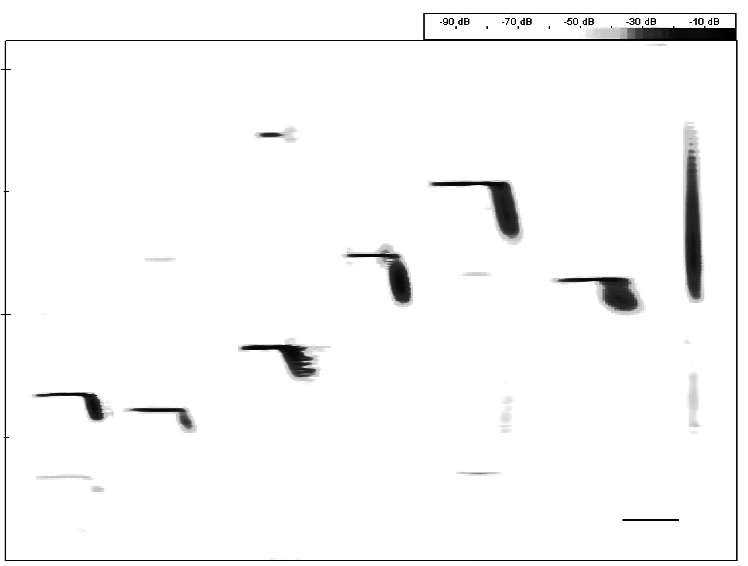
This is a common bat species in China. FA — 34.3–41.6 mm, mass — 3.3–7.8 g, FMAXE — 100.3–111.2 kHz. Capture sites included Beijing, Fujian, Guangdong, Guangxi, Guizhou, Hainan, Hubei, Jiangxi, Shandong, Sichuan and Yunnan. Among these sites, bats from Beijing were larger than others ( FA 40.2–41.6 mm) and had a lower call frequency, ranging 105.2–109.7 kHz. For example, some R. pusillus from Guangxi called at a higher frequency (111.2 kHz) and are smaller ( FA 35.2–37.9 mm). Robinson (1996) reported that R. pusillus in Malaysia calls at 92.5 kHz ( FA 38.3 mm), and so it appears likely that cryptic species divisions are likely in this taxon across its range. Li et al. (2006) suggested that bat taxa R. pusillus (sampled across China), R. monoceros ( Taiwan), R. cornutus (main islands of Japan) and R. c. pumilus ( Okinawa, Japan) are better considered as geographical subspecies rather than distinct species. Simmons (2005) considers that R. cornutus is confined to Japan and, therefore, bats from China that were previously assigned to this taxon are now considered to belong to R. pusillus .
Previous records from China: Fujian, Guangdong, Guangxi, Guizhou, Hainan, Hebei, Hunan,
Jiangsu, Jiangxi, Shaanxi, Sichuan, Tibet, Yunnan and Zhejiang ( Zhang, 1997; Wang, 2003).
Ecological Notes
This is the most widespread and frequently encountered rhinolophid in China. It is rarely found in large numbers, and all records were from caves or once from a rock crevice. Five droppings collected in July 2002 from Beijing were analysed and found to contain (average percentage volume) 45% dipterans, 42% lepidopterans and 14% coleopterans. The diet is therefore similar to that of R. hipposideros in Europe ( Vaughan, 1997), which it resembles closely in morphology seemingly as a consequence of convergent evolution ( Li et al., 2006). Pregnant females were captured on 17 May, lactating females on 12 June 2005, in Guangxi.
Rhinolophus sinicus K. Andersen, 1905
Chinese rufous horseshoe bat
The species is most easily confused with R. affinis , from which it is best distinguished by its straight-sided lancet and the relatively short second phalanx of the third digit (<66% of the length of the metacarpal — Csorba et al., 2003). Unequivocal separation can seemingly be performed by sequencing the control region of mtDNA (authors’ unpublished data). Echolocation call frequencies overlap with those emitted by R. affinis . Rhinolophus affinis is also typically a larger species, though overlap occurs with R. sinicus at forearm lengths between 50–53 mm ( Fig. 4 View FIG ). Rhinolophus sinicus is very similar to R. thomasi from Myanmar, Vietnam, Lao PDR and Thailand, to which it is closely related and possibly conspecific. Call frequency for R. thomasi in Lao PDR is reported as 76–86 kHz ( Francis and Habersetzer 1998), and so the two taxa overlap considerably in call frequency. Rhinolophus thomasi is reported to have smaller upper canines than R. sinicus (Francis 2008) .
FA — 42.6–52.6 mm, mass — 8.5–14.3 g. Seventy-four males and 43 females were captured from Fujian, Guangdong, Guangxi, Guizhou, Hainan, Hubei, Jiangxi, Sichuan, and Yunnan. The echolocation calls vary over the geographic range, from 73.4–88.5 kHz. The call frequencies ( 0 ± SD) of a sample of males (82.0 ± 2.0 kHz, n = 38) were lower than females (85.4 ± 1.9, n = 29 — Mann- Whitney W = 839, P <0.001), but the forearm lengths were not significantly different between sexes ( ♂♂: 46.9 ± 1.5, n = 37; ♀♀: 46.6 ± 2.0, n = 29; Mann-Whitney W = 1325, P > 0.05).
Previous records from China:, Anhui, Fujian, Gansu, Guangdong, Guangxi, Guizhou, Hainan, Hubei Jiangsu, Jiangxi, Shaanxi, Sichuan, Tibet, Yunnan, Zhejiang ( Zhang, 1997; Wang, 2003).
Ecological Notes
Widespread in caves in southern China, but never abundant. Maximum count was 24 bats in one cave in Jiangxi. An abandoned brick kiln was used by a solitary male in Xinyi County.
Rhinolophus stheno K. Andersen, 1905 Lesser brown horseshoe bat
FA — 41.8–47.1 mm, mass — 10.3 ± 1.4 g ( n = 6). Four males and three females were captured in Yunnan Province. These were the first records of R. stheno from China, and a detailed description was given in Zhang J. S. et al. (2005). The echolocation calls indicated that the FMAXE of R. stheno was about 87.2 kHz, while Robinson (1996) reported 85–90 kHz ( FA 46 mm), and Kingston et al. (2000) documented 86.1 kHz ( FA 48.8 mm), both in Malaysia.
Soisook et al. (2008) recently elevated R. microglobosus to species status and consider it distinct from R. stheno in Southeast Asia. Whereas R. stheno typically echolocates with FMAXE of 85–88 kHz, R. microglobosus calls at 92–101 kHz. Rhinolophus stheno had forearm lengths between 43.2–48.1 mm, whereas R. microglobosus was smaller on average ( FA — 41.4–46.3 mm). Rhinolophus stheno was found in the Thai-Malaysian peninsular and central Vietnam, with R. microglobosus distributed further north, also in Myanmar, Cambodia, Vietnam, and Lao PDR and hence closer to the border with China ( Soisook et al., 2008). Nonetheless, our echolocation call frequency measurements are consistent with the Chinese bats being R. stheno rather than R. microglobosus .
Ecological Notes
These records were the first for China: the bats were roosting in caves.
Rhinolophus sinicus K. Andersen, 1905
Chinese rufous horseshoe bat
The species is most easily confused with R. affinis , from which it is best distinguished by its straight-sided lancet and the relatively short second phalanx of the third digit (<66% of the length of the metacarpal — Csorba et al., 2003). Unequivocal separation can seemingly be performed by sequencing the control region of mtDNA (authors’ unpublished data). Echolocation call frequencies overlap with those emitted by R. affinis . Rhinolophus affinis is also typically a larger species, though overlap occurs with R. sinicus at forearm lengths between 50–53 mm ( Fig. 4 View FIG ). Rhinolophus sinicus is very similar to R. thomasi from Myanmar, Vietnam, Lao PDR and Thailand, to which it is closely related and possibly conspecific. Call frequency for R. thomasi in Lao PDR is reported as 76–86 kHz ( Francis and Habersetzer 1998), and so the two taxa overlap considerably in call frequency. Rhinolophus thomasi is reported to have smaller upper canines than R. sinicus (Francis 2008) .
FA — 42.6–52.6 mm, mass — 8.5–14.3 g. Seventy-four males and 43 females were captured from Fujian, Guangdong, Guangxi, Guizhou, Hainan, Hubei, Jiangxi, Sichuan, and Yunnan. The echolocation calls vary over the geographic range, from 73.4–88.5 kHz. The call frequencies ( 0 ± SD) of a sample of males (82.0 ± 2.0 kHz, n = 38) were lower than females (85.4 ± 1.9, n = 29 — Mann- Whitney W = 839, P <0.001), but the forearm lengths were not significantly different between sexes ( ♂♂: 46.9 ± 1.5, n = 37; ♀♀: 46.6 ± 2.0, n = 29; Mann-Whitney W = 1325, P > 0.05).
Previous records from China:, Anhui, Fujian, Gansu, Guangdong, Guangxi, Guizhou, Hainan, Hubei Jiangsu, Jiangxi, Shaanxi, Sichuan, Tibet, Yunnan, Zhejiang ( Zhang, 1997; Wang, 2003).
Ecological Notes
Widespread in caves in southern China, but never abundant. Maximum count was 24 bats in one cave in Jiangxi. An abandoned brick kiln was used by a solitary male in Xinyi County.
Rhinolophus stheno K. Andersen, 1905 Lesser brown horseshoe bat
FA — 41.8–47.1 mm, mass — 10.3 ± 1.4 g ( n = 6). Four males and three females were captured in Yunnan Province. These were the first records of R. stheno from China, and a detailed description was given in Zhang J. S. et al. (2005). The echolocation calls indicated that the FMAXE of R. stheno was about 87.2 kHz, while Robinson (1996) reported 85–90 kHz ( FA 46 mm), and Kingston et al. (2000) documented 86.1 kHz ( FA 48.8 mm), both in Malaysia.
Soisook et al. (2008) recently elevated R. microglobosus to species status and consider it distinct from R. stheno in Southeast Asia. Whereas R. stheno typically echolocates with FMAXE of 85–88 kHz, R. microglobosus calls at 92–101 kHz. Rhinolophus stheno had forearm lengths between 43.2–48.1 mm, whereas R. microglobosus was smaller on average ( FA — 41.4–46.3 mm). Rhinolophus stheno was found in the Thai-Malaysian peninsular and central Vietnam, with R. microglobosus distributed further north, also in Myanmar, Cambodia, Vietnam, and Lao PDR and hence closer to the border with China ( Soisook et al., 2008). Nonetheless, our echolocation call frequency measurements are consistent with the Chinese bats being R. stheno rather than R. microglobosus .
Ecological Notes
These records were the first for China: the bats were roosting in caves.
Rhinolophus stheno K. Andersen, 1905 Lesser brown horseshoe bat
FA — 41.8–47.1 mm, mass — 10.3 ± 1.4 g ( n = 6). Four males and three females were captured in Yunnan Province. These were the first records of R. stheno from China, and a detailed description was given in Zhang J. S. et al. (2005). The echolocation calls indicated that the FMAXE of R. stheno was about 87.2 kHz, while Robinson (1996) reported 85–90 kHz ( FA 46 mm), and Kingston et al. (2000) documented 86.1 kHz ( FA 48.8 mm), both in Malaysia.
Soisook et al. (2008) recently elevated R. microglobosus to species status and consider it distinct from R. stheno in Southeast Asia. Whereas R. stheno typically echolocates with FMAXE of 85–88 kHz, R. microglobosus calls at 92–101 kHz. Rhinolophus stheno had forearm lengths between 43.2–48.1 mm, whereas R. microglobosus was smaller on average ( FA — 41.4–46.3 mm). Rhinolophus stheno was found in the Thai-Malaysian peninsular and central Vietnam, with R. microglobosus distributed further north, also in Myanmar, Cambodia, Vietnam, and Lao PDR and hence closer to the border with China ( Soisook et al., 2008). Nonetheless, our echolocation call frequency measurements are consistent with the Chinese bats being R. stheno rather than R. microglobosus .
Ecological Notes
These records were the first for China: the bats were roosting in caves.
No known copyright restrictions apply. See Agosti, D., Egloff, W., 2009. Taxonomic information exchange and copyright: the Plazi approach. BMC Research Notes 2009, 2:53 for further explanation.
|
Kingdom |
|
|
Phylum |
|
|
Class |
|
|
Order |
|
|
Family |
|
|
Genus |