
Eudarcia glaseri
|
publication ID |
https://doi.org/10.11646/zootaxa.4179.3.9 |
|
publication LSID |
lsid:zoobank.org:pub:A25BCD87-8E83-4380-8CF7-A9CD6FB12A3B |
|
DOI |
https://doi.org/10.5281/zenodo.6087265 |
|
persistent identifier |
https://treatment.plazi.org/id/038487B8-FFD5-F165-FF24-FEB0A488FCE7 |
|
treatment provided by |
Plazi |
|
scientific name |
Eudarcia glaseri |
| status |
|
Key to the species of the Eudarcia glaseri View in CoL -group based on external and on genitalia characters
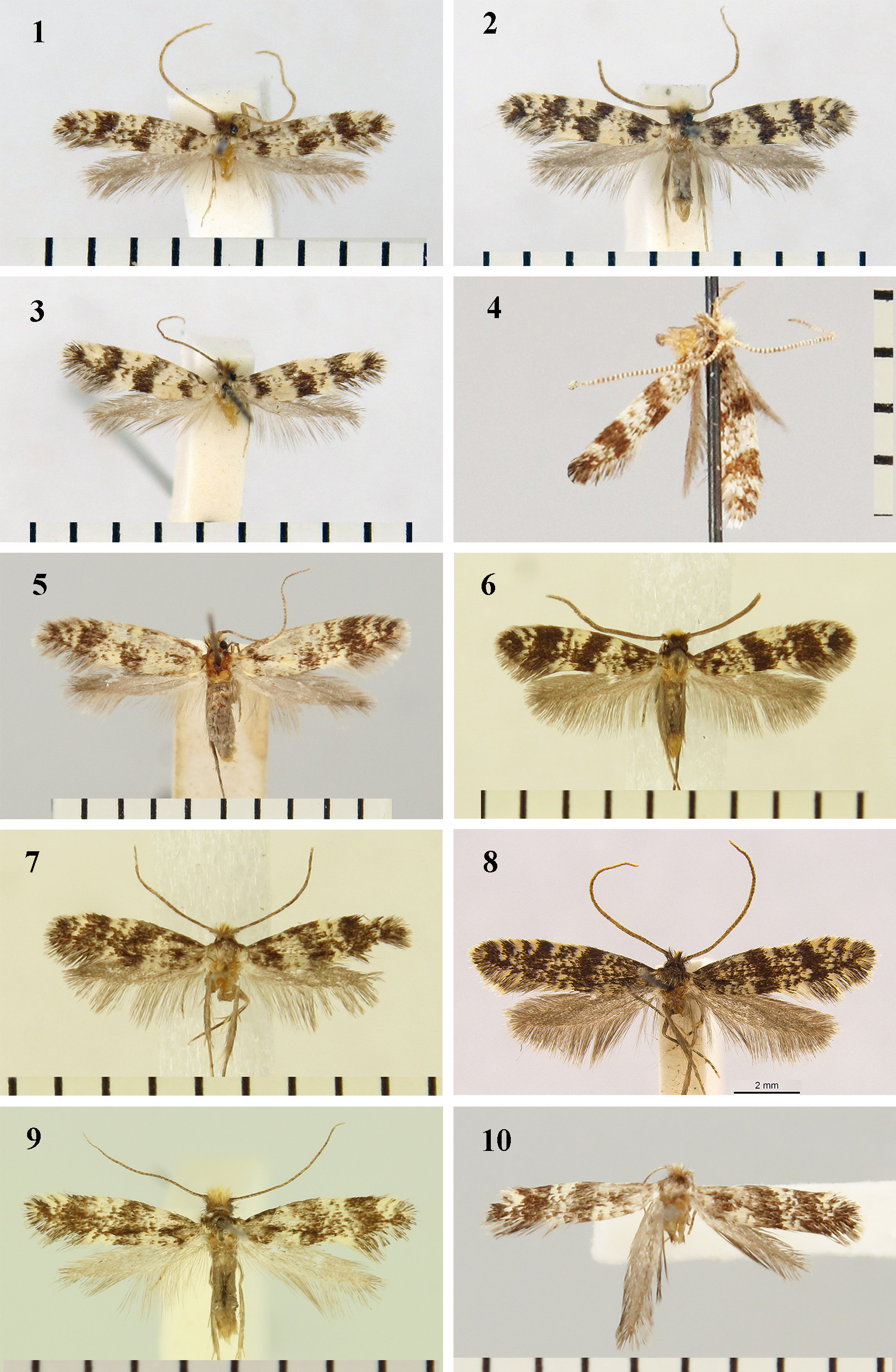
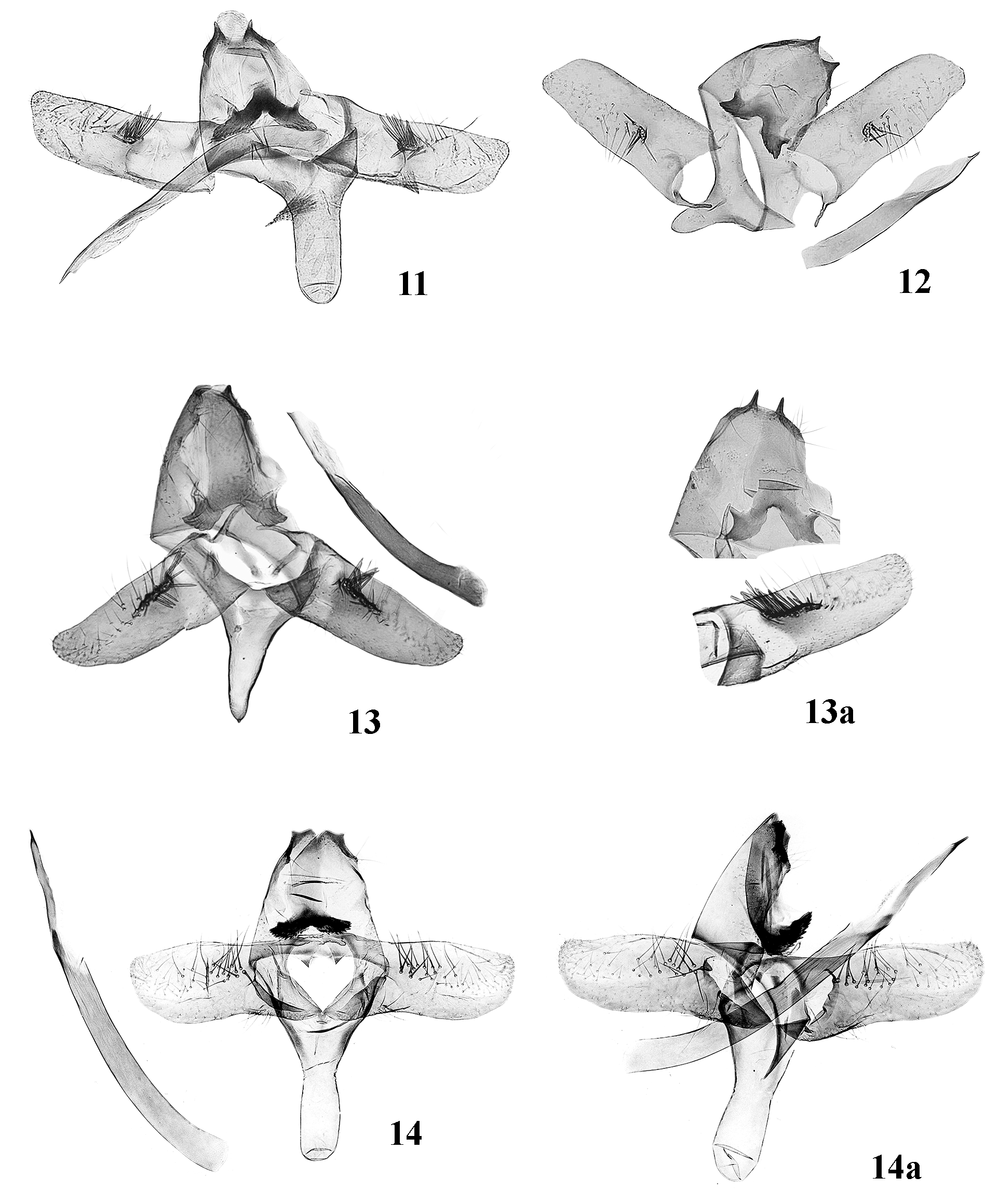
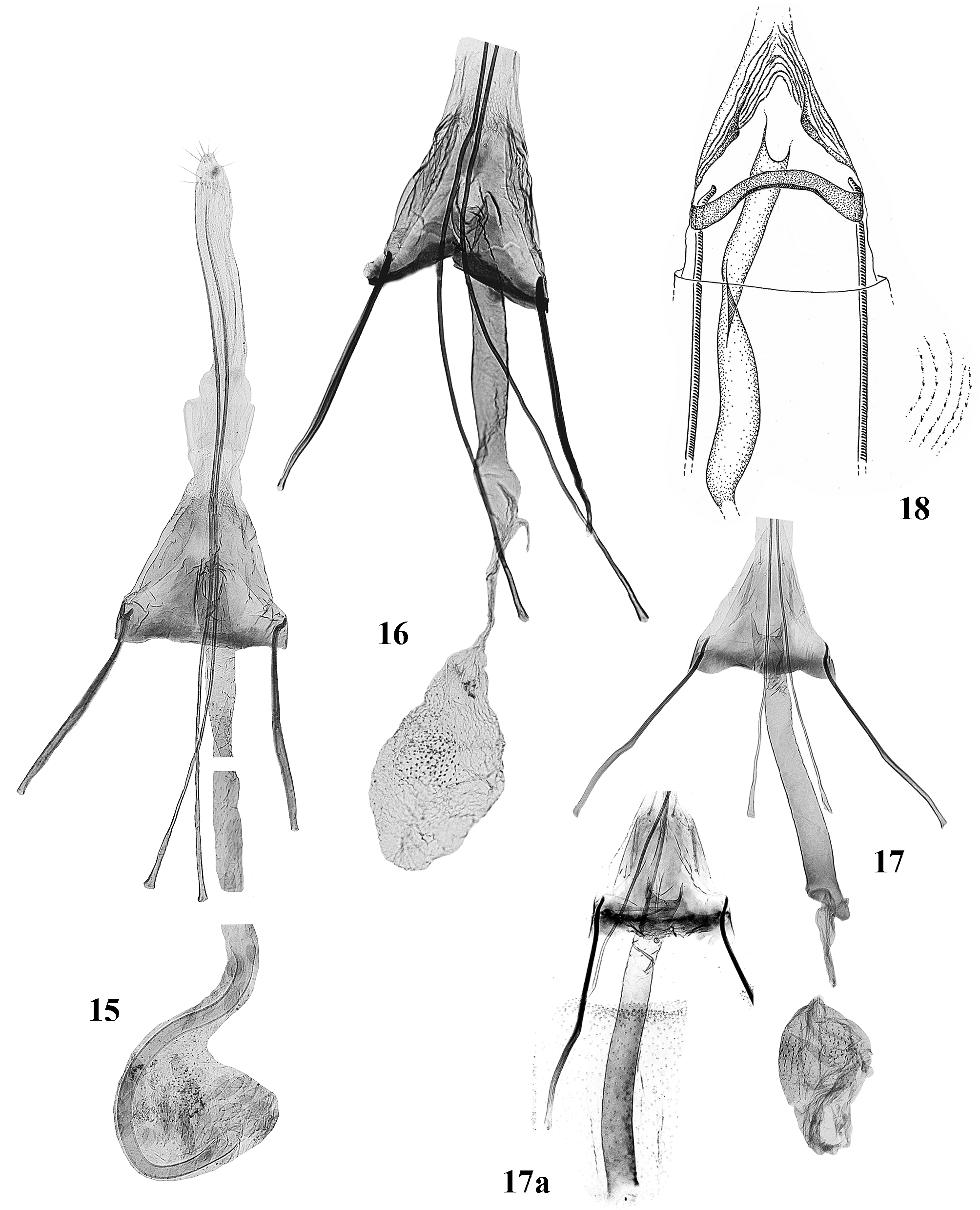
1. Frons with tuft of yellowish-orange scales, black pattern on the forewing well developed, wingspan 8.0– 8.5 mm ( Figs 6–7 View FIGURES 1 – 10 ). Uncus projections very short, valva without row or tuft of setae in middle, saccus long, weakly constricted in middle ( Figs 14– 14 View FIGURES 11 – 14 a). Caudal sclerotized portion about 3/4 length of the ductus bursae, antevaginal plate weakly sclerotized, signa forming large paired clusters of rows of small thorns ( Figs 17–17 View FIGURES 15 – 18 a)...................................... E. ignorata sp. n.
- Frons with tuft of dirty-white scales, black pattern on the forewing weakly developed, wingspan 6.3–10.8 mm ( Figs 1–5 View FIGURES 1 – 10 ). Uncus projections long, valva with row or with tuft of strong stake-shaped or pointed setae in middle, saccus shorter, not constricted in middle ( Figs 11–13 View FIGURES 11 – 14 a). Caudal sclerotized portion from 2/5 to 3/5 length of the ductus bursae, antevaginal plate well sclerotized, signa forming an irregular cluster of small thorns ( Figs 15–16 View FIGURES 15 – 18 )........................................ 2
2. Wingspan 6.3 mm ( Fig. 4 View FIGURES 1 – 10 ). Valva with small tuft of short, comparatively weak setae, phallus comparatively short (1.1 times longer than the length of valva) and broad, saccus 1/3 length of valva ( Fig. 12 View FIGURES 11 – 14 ). Female unknown........ E. saxatilis sp. n.
- Wingspan 7.0– 10.8 mm ( Figs 1–3, 5 View FIGURES 1 – 10 ). Valva with large tuft or with row of strong pointed setae in middle, phallus comparatively long (1.4–1.6 times longer than the length of valva) and narrow, saccus longer than 1/3 of valva ( Figs 11, 13–13 View FIGURES 11 – 14 a).... 3
3. Wingspan 7.0– 9.8 mm ( Figs 1–3 View FIGURES 1 – 10 ). Uncus projections comparatively long, valva with tuft of strong pointed setae before middle, saccus sub-rectangular with rounded apex ( Fig. 11 View FIGURES 11 – 14 ). Caudal sclerotized portion about 2/5 length of the ductus bursae and distinctly longer than apophyses anteriores, signa forming a single cluster of small thorns ( Fig. 15 View FIGURES 15 – 18 )................ E. glaseri View in CoL
- Wingspan 8.0– 10.8 mm ( Fig. 5 View FIGURES 1 – 10 ). Uncus projections comparatively short, valva with long row of stick-shaped setae in middle, saccus sub-triangular, tapered apically ( Figs 13–13 View FIGURES 11 – 14 a). Caudal sclerotized portion about 3/5 length of the ductus bursae and shorter than apophyses anteriores, signa forming a paired large clusters of small thorns ( Fig. 16 View FIGURES 15 – 18 )........... E. abchasicum
No known copyright restrictions apply. See Agosti, D., Egloff, W., 2009. Taxonomic information exchange and copyright: the Plazi approach. BMC Research Notes 2009, 2:53 for further explanation.
|
Kingdom |
|
|
Phylum |
|
|
Class |
|
|
Order |
|
|
Family |
|
|
Genus |